"Hold pressure. Let the right parts through. Do hard things. Stay human."
Adam Kreek
ViDA founder and executive coach
- Date
The ViDA Leadership Operating System: Where to Put Your Effort
posted in Built For Hard

Adam Kreek
You know the meeting. A deadline is slipping. You ask for an update, hear two versions of what happened, and take the decision back. The meeting ends with a plan. By Friday, three more decisions are sitting with you, and the people closest to the work are waiting for your answer.
Taking over may have been the right call that morning. If it becomes the way every hard decision gets made, you’ve taught the team to wait. The difficult work now is to see why you keep reaching for the same move and decide where a different one could do more good.
That’s why I’m developing Integrated Stewardship Theory and the ViDA Leadership Operating System. I want leaders to see more of what’s happening under pressure, then choose a change that serves what they value most and improves life for the people and systems in their care. A better result matters. So does what people learn, what they can carry next time, and what the work costs them.
Why integrated stewardship?
Here’s the working thesis: when leaders see where pressure is shaping their behaviour and what that behaviour is teaching the system, they can put their effort where it is more likely to make a meaningful difference. The change might start with one person. Its effects can reach a team, a family, or an organization.
Our Built for Hard coaching philosophy starts with the belief that there is nothing wrong with you and that behaviour has a positive intention, even when its effects need to change. Change is inevitable. Choosing how to engage with it gives us more agency. The part of you that takes over may be trying to protect quality. When you can see the intention and the cost, you have a better chance of protecting the standard while giving other people room to grow.
Some of this work will hurt. Letting a capable person do something their own way can be uncomfortable. So can admitting that the way you’ve set up the work sends every hard call back to you. Sometimes the most useful change is to remove a burden the system should never have asked anyone to carry. The point is to make the hard work count.
Integrated Stewardship Theory explains how pressure activates parts of us and travels through our roles, relationships and systems. Permeable containment is the central mechanism: it gives us a choice about what moves through us and where it goes. The ViDA Leadership Operating System is how we train those choices in the work we already do.
What to hold, what to let through
Parts are real aspects of you: the competitor who wants to win, the protector who spots risk, the rescuer who jumps in.
Masks are the faces we put forward to meet a situation. The composed executive can help a room settle. The executive who always has the answer can make it hard for anyone else to think aloud.
Shadows are parts we don’t recognize or readily own, even though they still shape what we do. You may think you’re protecting the quality of a decision while also protecting the feeling of being indispensable.
Backstage is where you examine that reaction, get feedback and decide what it’s trying to protect. Front stage is where you bring what the work and the relationship need. In the deadline meeting, you can let your concern for quality through as a clear standard and a direct question. Your fear that the team will get it wrong might need a different place to go. You can also let someone else’s account of the risk change your mind.
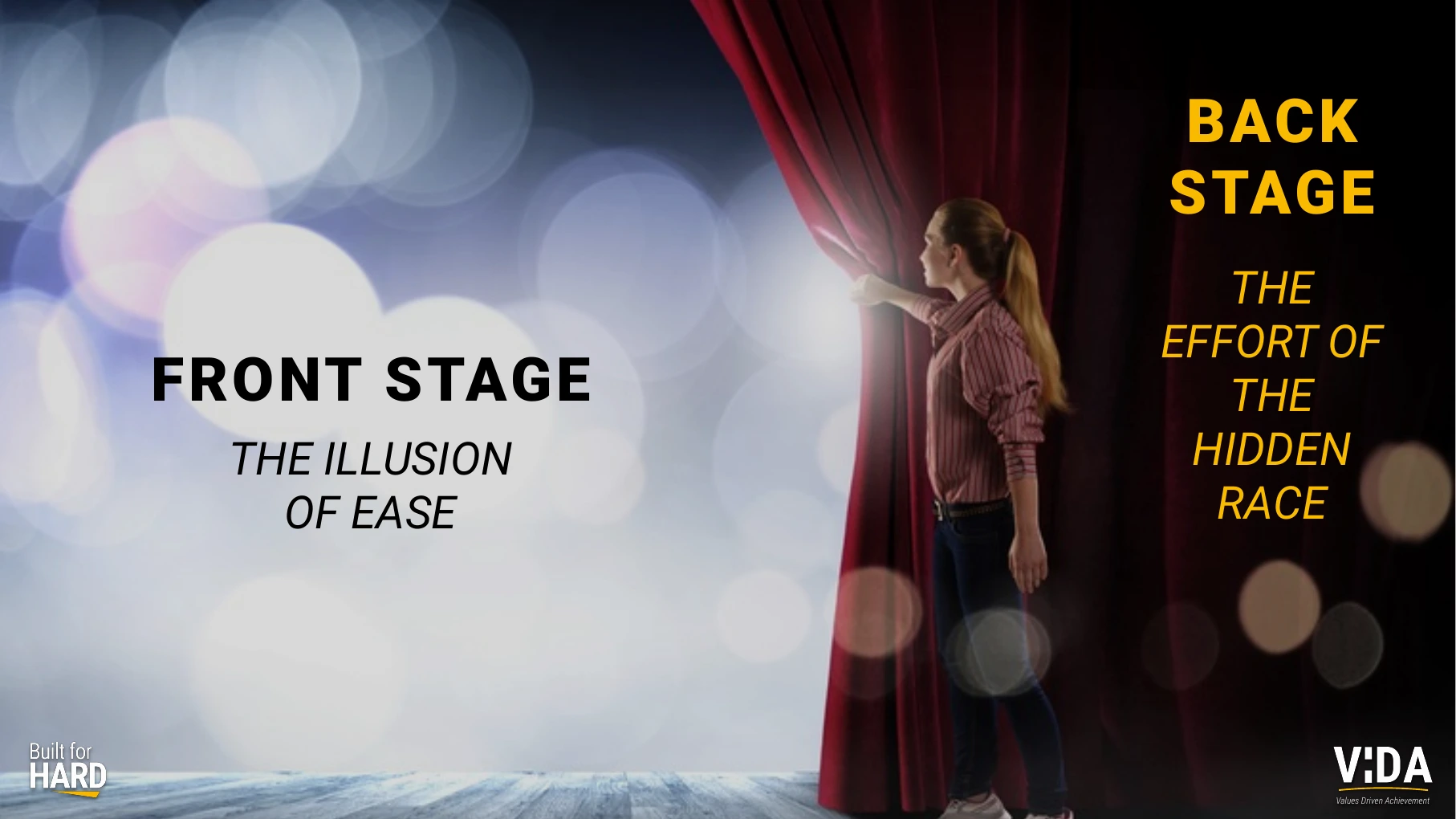
That’s permeable containment. Under pressure, we can let too much spill out or hold on to too much ourselves. The skill is to choose what to hold, express, share or process elsewhere. The companion article on permeable containment goes deeper into both patterns and what to do about them.
The pyramid: five capacities on one foundation
Permeable containment is the foundation and something we practise through all five capacities. The foundation starts with parts, masks and shadows. Looking closely at them helps us see which values we’re protecting, where we need a boundary or support, and what we may need to repair.
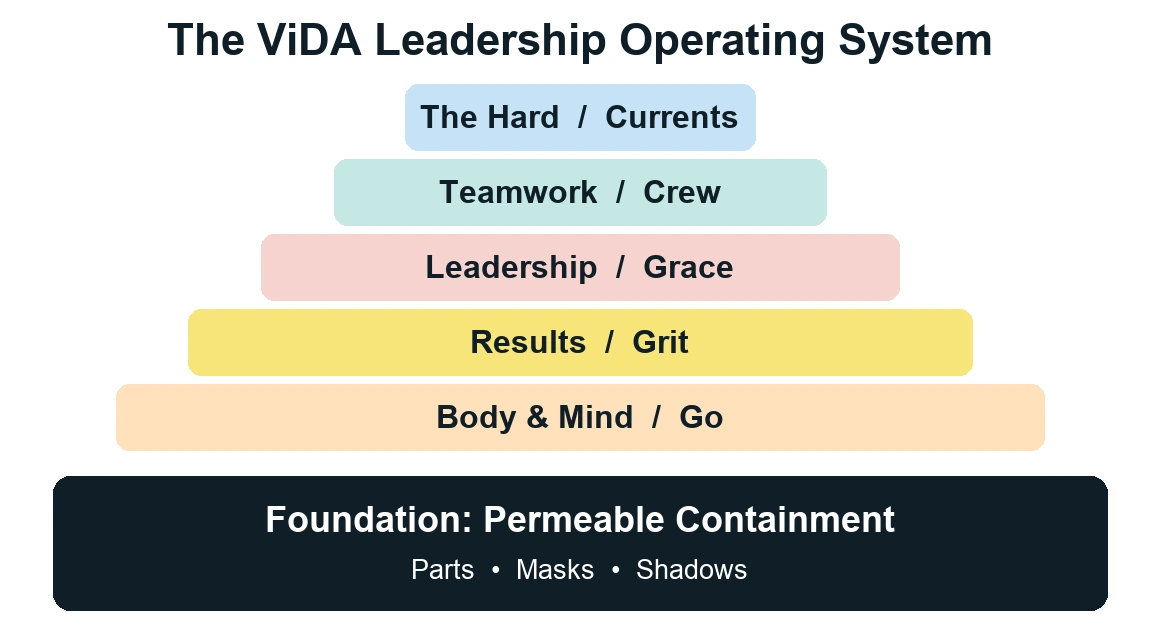
Body & Mind (Go). Manage the energy, attention and recovery you bring to the job. If you walk into every meeting depleted, even a good plan will be harder to carry out.
Results (Grit). Make the outcome clear and organize the work that moves it. Choose priorities, define what progress looks like and review it often enough to act.
Leadership (Grace). Help people get results when you hold formal authority. Your role gives you the power to direct work, make a call and require people to follow it. Use that authority to clarify who decides, coach judgment and hold the standard. In rowing terms, Grit is the yellow oar and Grace is the red one. One moves the task forward; the other builds the capacity of the people doing it. Learn to use both.
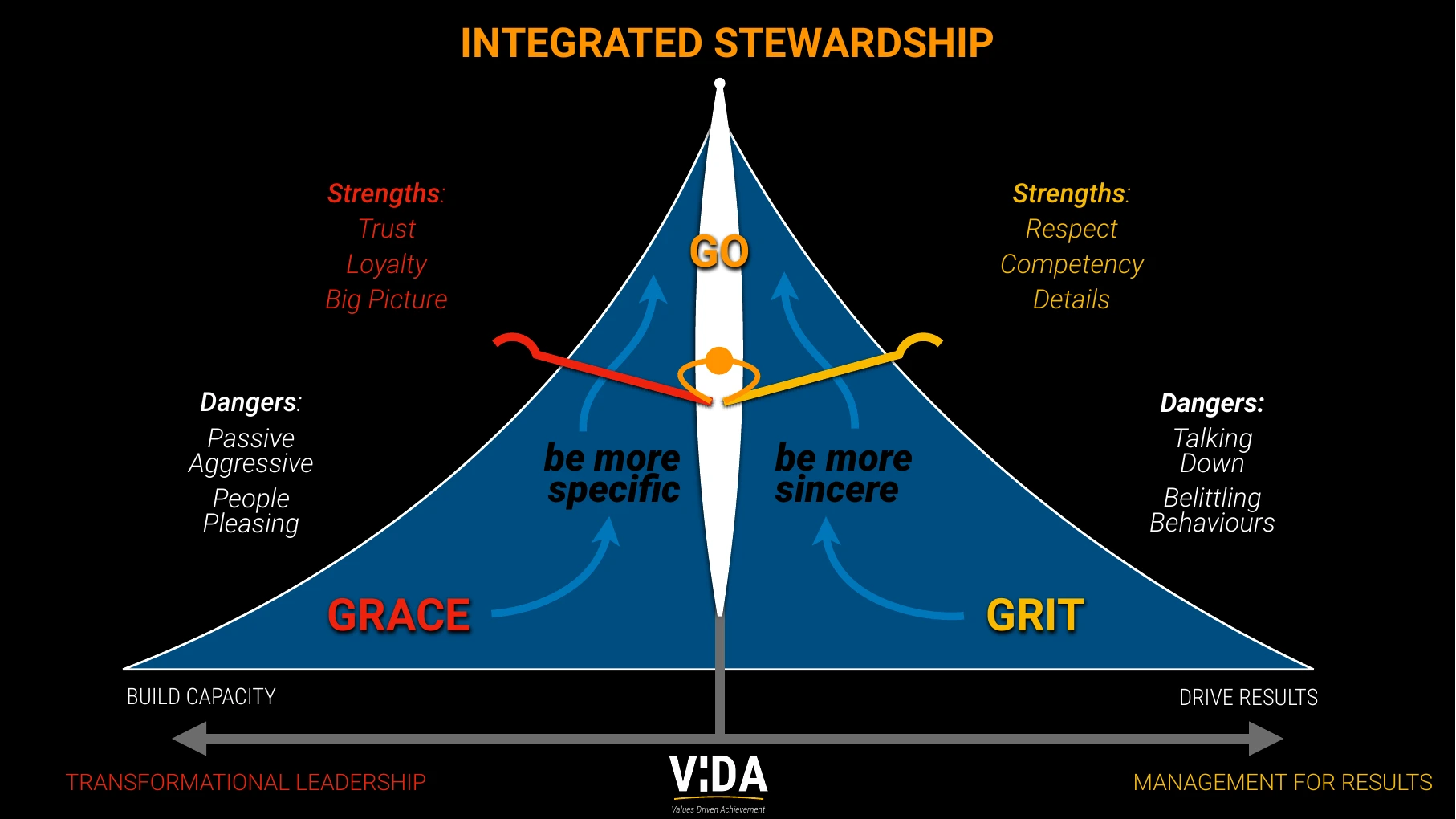
Teamwork (Crew). Lead without a title. When you can’t compel a peer to act, your power comes from trust, credibility and the ability to bring people together around a shared purpose. Make it easier to coordinate, disagree, ask for help and repair trust. A team should be able to work through a problem while the boss is away.
The Hard (Currents). Adapt when the conditions change. Under uncertainty, decide what to protect, what to adjust and what to learn before the next round.
Self-determination theory, developed by Richard Ryan and Edward Deci, is a thread running through all five capacities. It points to three needs that support motivation: autonomy, or having a meaningful sense of choice; competence, or feeling able to act effectively; and relatedness, or feeling connected to others. In the deadline example, a team lead needs real decision room, a chance to build judgment and confidence that asking for help won’t cost them ownership. Those conditions matter across Work, Life and Self.
The 3 × 5 grid: find where a change could matter most
Cross the five capacities with three arenas: Work, where we create economic value through our work and organizations; Life, where we create social value through family, friendships and community; and Self, where we build inner value through health, energy, alignment and meaning. The same pattern can show up in more than one place. A stretch of poor recovery in Self can make you quicker to take over at Work; carrying every decision at Work can leave you with very little attention for Life. You can learn more about achieving the right balance between work, life and self in my post about XYZ.
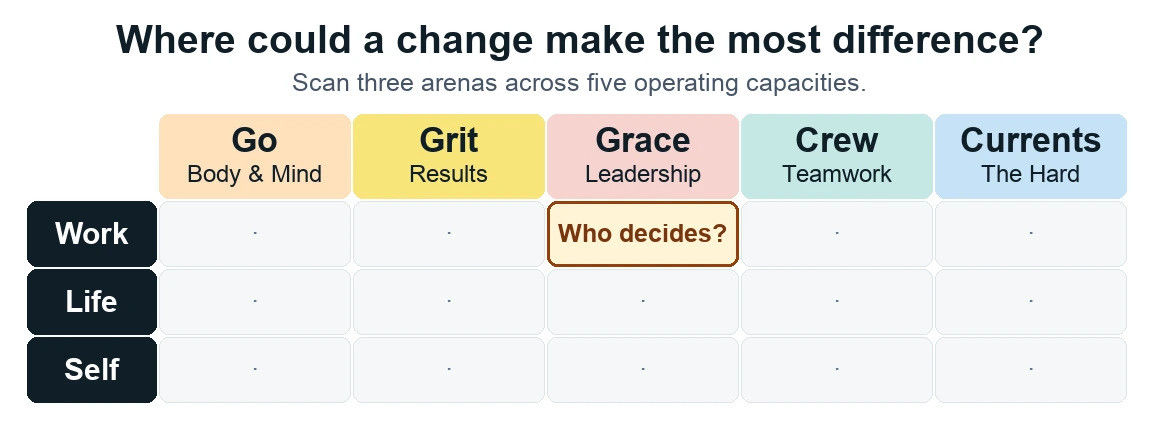
Start with a recent, consequential moment. Find the cell where the cost is easiest to see, then look across the grid for what is sustaining the pattern. Where is pressure spilling? What are you holding that someone else could carry? What would give the right person more room to act? Look for one change that honours something you value and could help beyond that moment. The grid gives you a place to look. What happens next tells you whether you looked in the right place.
Turn the diagnosis into a transformational thesis
A transformational thesis is a testable idea about where to put your effort. Name the pattern, the value at stake, what you’ll change, and what you expect to see if the change helps.
Suppose the deadline pattern sits at Work × Leadership. You value quality and want the team to develop better judgment. Under pressure, the protector in you becomes the rescuer. The role of “the person with the answer” feels useful. It also leaves you holding decisions the team could learn to make. Rehearsing a pause and a question before the meeting is useful backstage work. The structure needs to change, too: if no one knows which calls they own or when to escalate, they’ve got a good reason to wait.
For the next four weeks, I’ll give the project lead authority to make routine trade-offs within agreed limits. We’ll name the risks that still need escalation and review a few decisions together each Friday. If this is the right focus, more decisions will get made at the right level, and our delivery and quality standards will hold.
At the review, look at who made the calls, whether quality held and what the lead learned. Ask whether the team had enough support. If the new arrangement fails, get specific: were the limits unclear, did people need more practice, or did you take the decision back when it got uncomfortable? Adjust the next experiment accordingly.
Take one decision you keep taking back. What value are you trying to protect? Where are you carrying more than the role calls for? What could you change so the standard is clear and someone else gets to practise the judgment you want them to build?
If you’re working through a change like this, ViDA executive coaching can help you decide where to focus and test your thesis in the work you already do.
Adam Kreek
Portrait from the Adam Kreek collection.