
"What is my leadership recipe right now?What ingredient do I need to add next?"
Adam Kreek
Founder Built for Hard
- Date
What’s Your Recipe for Leadership?
posted in Built For Hard tools

Adam Kreek
How to choose the right leadership style under pressure
Under pressure, most leaders do not rise to their most enlightened leadership style.
They fall back to their most familiar one.
The pacesetter pushes harder.
The visionary paints a bigger picture.
The affiliative leader protects the relationship.
The democratic leader asks for more input.
The commanding leader takes control.
The coaching leader asks another question.
None of these styles are wrong.
The problem (often) is when you're using the same style in every situation.
A leader who only knows how to drive pace will eventually create exhaustion.
A leader who only knows how to protect harmony will eventually avoid truth.
A leader who only knows how to inspire will eventually frustrate the people who need clarity, structure, and follow-through.
Leadership maturity is not about finding your one perfect style.
It is about building your range.
The better question is not:
What kind of leader am I?
The better question is:
What does this person, team, and moment require from me?
That is where Daniel Goleman’s six leadership styles become useful.
Not as labels.
Not as personality boxes.
As tools.
And like all tools, the value comes from knowing when to use them, when to put them down, and when your favourite tool is starting to damage the work.
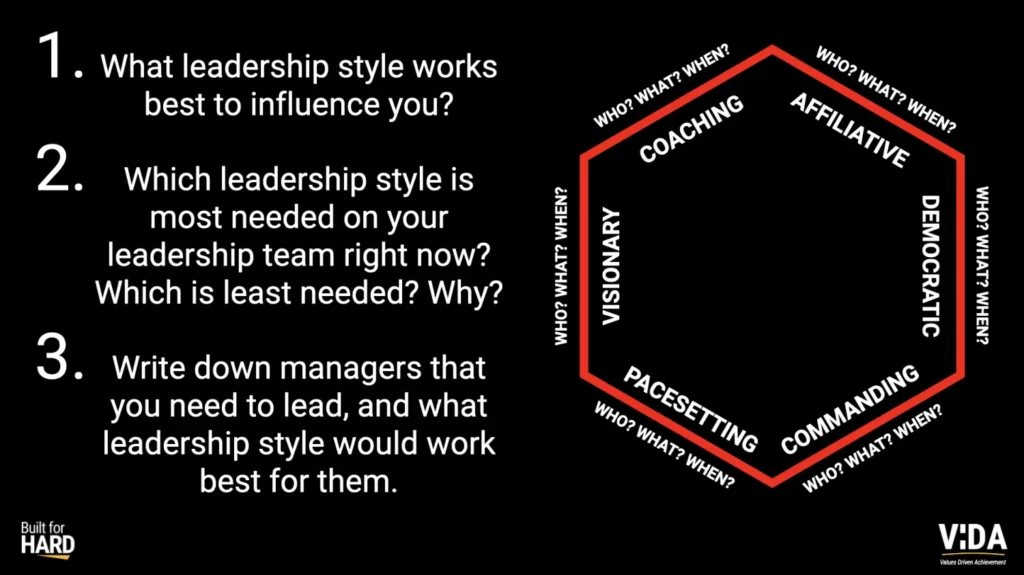
Goleman’s six leadership styles
In his Harvard Business Review article, Leadership That Gets Results, Daniel Goleman argued that the most effective executives do not rely on one leadership style. They use a range of styles, in different measures, depending on the situation. The underlying research connected leadership behaviour to organizational climate and performance, especially through factors such as clarity, commitment, responsibility, standards, flexibility, and rewards.
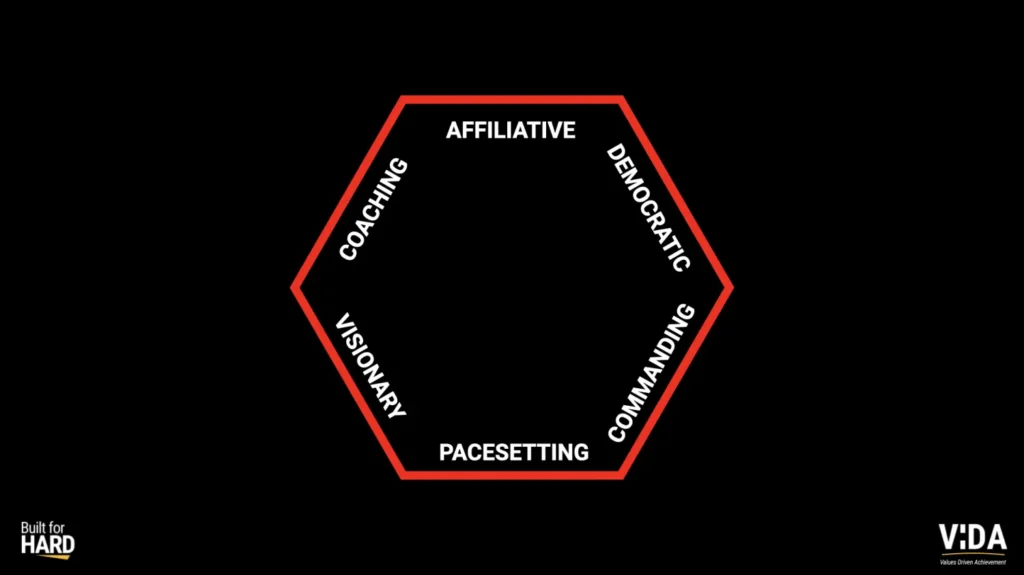
The six styles are:
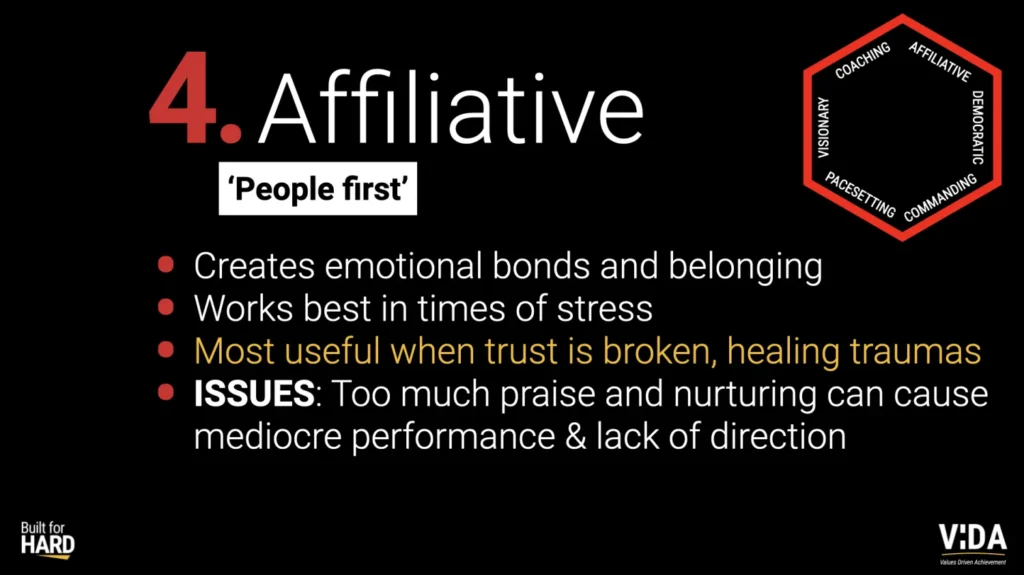
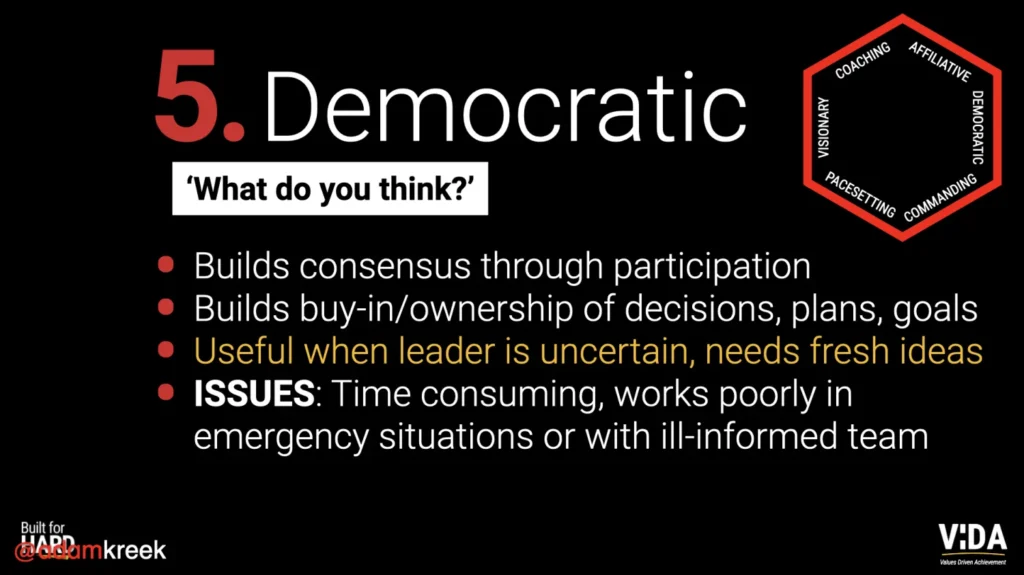
In the ViDA facilitation structure, the exercise is simple: learn the six styles, identify which style each leader tends to embody, and then discuss what the team needs more or less of right now. The PDF also uses the useful question: What’s your recipe for leadership?
That metaphor matters.
Because most leaders are not one ingredient.
You may need two cups visionary, one cup coaching, one cup affiliative, a dash of pacesetting, and a pinch of commanding.
But if you dump in the whole bag of pacesetting, don’t be surprised when the team burns out.
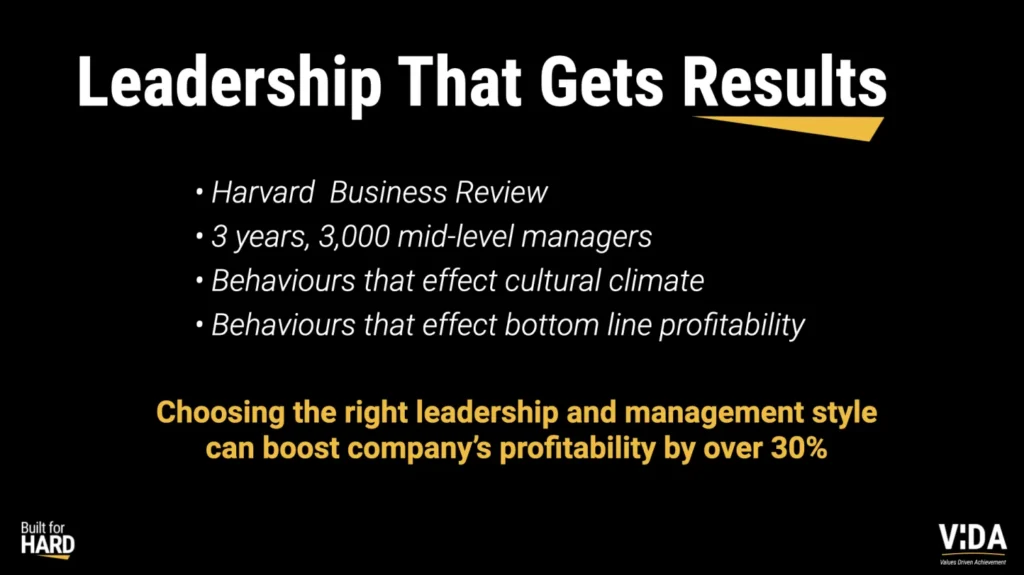
Leadership style creates climate
Your leadership style is not just how you express yourself.
It becomes the weather system other people work inside.
If you are reactive, the room tightens.
If you are vague, the room fills in the blanks.
If you are avoidant, the hard truth goes underground.
If you are controlling, people stop bringing you the truth.
If you are clear and steady, the team can breathe and move.
This connects directly to the core idea in Above the Waterline Leadership: you can still hold standards, tell the truth, make hard calls, and hold people accountable, but you do it from a different state. The work is not to never drop below the waterline. The work is to notice faster, recover better, and choose responsibility.
That is leadership range.
The point is not to become softer.
The point is to become more useful.
The shadow side of every leadership strength
Every leadership style has a gift.
Every leadership style also has a shadow.
The visionary creates direction.
The shadow is transmission failure.
The coach develops people.
The shadow is over-questioning when clarity is needed.
The affiliative leader builds trust.
The shadow is avoiding the hard conversation.
The democratic leader builds ownership.
The shadow is slow consensus when a decision is needed.
The pacesetter raises standards.
The shadow is dependence, resentment, and burnout.
The commanding leader creates order in crisis.
The shadow is compliance without commitment.
The mature leader does not abandon their natural style. They learn its cost.
That is why this work belongs inside leadership containment. Containment is not softness. It is the disciplined ability to stay grounded, clear, and useful under load. The ViDA blog already frames containment as “strength with discipline,” which is exactly the lens this article should build from.
Under pressure, your leadership style can become either a tool or a leak.
The question is whether you are choosing the style, or whether the style is choosing you.
Case Study 1: The pacesetter who could see everything except what his team needed
He had been in the company long enough to know how everything worked.
That was part of the problem.
He was the person people turned to when things got complicated. He could diagnose a broken system quickly. He knew where the hidden risks were. He had high standards, fast thinking, and a low tolerance for drift.
His instinct when something went wrong was to fix it.
And often, he was right.
But at some point in the coaching conversation, something honest came out. He felt aimless. He knew there was a level of leadership he was missing, but he kept dancing around the edges of it. He was performing, but he was not necessarily building the team.
That is the pacesetter’s trap.
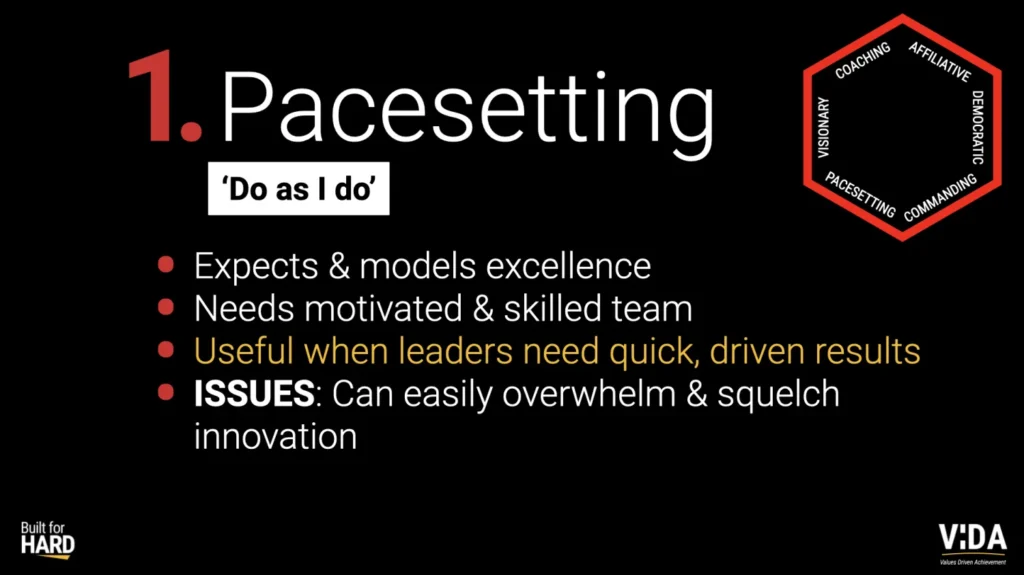
Pacesetters produce results. They model excellence. They often are the most technically capable person in the room. But the shadow of pacesetting is this:
The team slowly learns that their job is not to grow.
Their job is to not fall short.
So they wait.
They second-guess.
They bring fewer ideas.
They look to the high performer to rescue the work.
The leader becomes the standard, the engine, the quality control system, and the bottleneck.
This is where pacesetting must be paired with coaching.
The shift was not to lower the bar.
The shift was to ask a better question:
What would need to be true for someone on my team to handle this without me next time?
That question changes the work.
Instead of jumping in to fix, the leader pauses.
Instead of silently judging, the leader names the standard.
Instead of carrying the complexity alone, the leader teaches others how to carry more of it.
That is the difference between being a high performer and being a leader.
High performers raise the standard through their own output.
Leaders raise the standard through the capacity they leave in others.
This connects directly to the ViDA idea in Build Boat Speed, Not Burnout: until you have documented, repeatable, scalable systems, you do not have a business; you have a hustle. The same is true for leadership. Until others can carry the work without you, you do not have leadership capacity. You have personal heroics.
Case Study 2: The visionary who forgot to transmit
He could describe the future of his company in vivid detail.
Multiple locations.
A stronger brand.
A business that could run without him.
More enterprise value.
More freedom.
He was thinking at the right altitude.
But back inside the business, a key operations leader was still unclear about what mattered most. The founder was frustrated. The operator did not seem to know what to do without being told.
Then came the uncomfortable truth:
The expectations had never been written down.
The annual plan lived in the founder’s head.
The role clarity lived in the founder’s head.
The future of the company lived in the founder’s head.
The performance standard lived in the founder’s head.
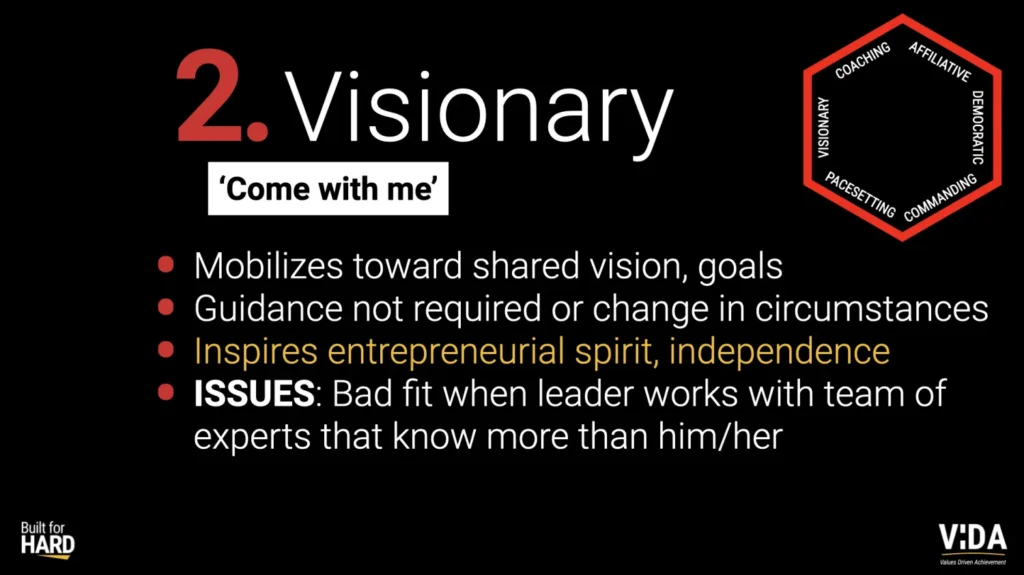
That is the visionary’s trap.
Visionary leaders see things before others see them. That is the gift. They can pull people toward a future that does not exist yet.
But seeing clearly is not the same as communicating clearly.
A vision that lives only inside the leader’s head is not a vision.
It is a private movie.
The coaching reframe was simple:
Your job is not just to hold the vision. Your job is to transmit it.
That meant writing things down.
Not because paperwork is inspiring.
Because clarity is kind.
The practical shifts were straightforward:
Create an annual planning rhythm.
Define roles and accountabilities.
Hold monthly structured check-ins.
Write down what success looks like before the next hard conversation.
The issue was not necessarily that the operations leader lacked capability.
The issue was that he had never been given the runway.
This is where visionary leadership needs democratic and coaching layers. Not to slow the vision down, but to create shared ownership of it.
The ViDA blog post From Big Goal to Launch Plan makes this point in another form: big ideas need small strategic actions. A team can agree with the goal and still fail to execute if the path, roles, and next moves are not clear.
Great leaders do not just see further.
They build the road that lets the team catch up.
Case Study 3: The Coaching Leader Who Had to Stop Rescuing
He was managing a growing team through a period of rapid change.
New demands. New executives. More pressure. More people. More complexity.
He was smart, responsible, and deeply committed. He was also exhausted in the specific way capable people get exhausted: by carrying weight that should belong to others.
In the coaching conversation, the pattern showed up quickly.
When a direct report froze, he unfroze them.
When someone needed to learn project management, he managed the project.
When ambiguity appeared, he stepped into it.
The work was not failing.
But neither was anyone else growing.
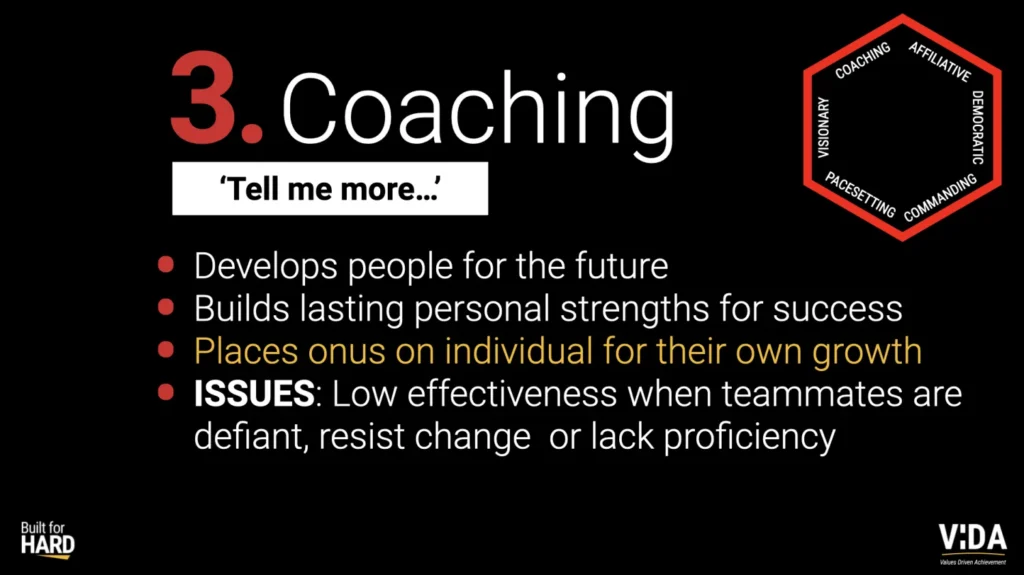
That is the coaching leader’s trap. Not because they coach too much, but because they confuse care with rescue. They want people to succeed, so they step in too early. They answer the question. They solve the problem. They smooth the path.
And every time they do, they remove the friction that would have built strength.
The shift started with one question:
Who on your team is ready to manage someone?
He had an answer immediately.
That mattered.
Coaching does not require a grand leadership transformation. It starts with one real opportunity to let someone else carry more. In this case, that meant giving a capable direct report responsibility for two new hires: real ownership, real expectations, real follow-up.
Not a suggestion.
Responsibility.
His job was to stop being the answer machine and start becoming the development system. That meant asking better questions in one-on-ones. It meant shifting from status updates to capability: What did you figure out this week that you could not figure out last week?
It meant tolerating the temporary inefficiency of someone else learning.
Coaching is not rescuing.
It is building another person’s capacity to carry more.
Case Study 4: The affiliative leader learning when harmony becomes a liability
He was the kind of leader people trusted.
Calm.
Present.
Good at listening.
Deeply empathetic.
People came to him with hard things. His team respected him. His bosses valued him. He genuinely cared about the people inside the business.
But his 360 feedback carried a thread he could not ignore:
Empathy had become a blind spot.
He was giving underperformers one more chance, then another, then another. He was protecting harmony when the moment needed clarity. He was building consensus when someone needed to make the call. He was showing care, but sometimes care had started to look like avoidance.
That is the affiliative leader’s trap.
Affiliative leaders build trust. They create belonging. They help people feel seen.
But warmth alone does not tell anyone where to go.
The coaching insight was not:
Be less caring.
The insight was:
Caring without accountability is not care. It is conflict avoidance with good intentions.
Real care includes the hard conversation.
Real care says:
I am telling you this because I believe you can do better.
I am not going to pretend the issue is smaller than it is just to protect the comfort in this room.
The shift was not about becoming harsher.
It was about becoming clearer.
We worked on three practical behaviours:
Start one-on-ones with the relationship, then move to the task list.
Communicate upward with more proactive clarity instead of waiting for permission.
Create peer agreements where others could call him in when he moved too fast or failed to bring them along.
Affiliative leaders do not need to abandon care.
They need to add a narrow range of directness.
This is where the ViDA Grit-Grace Scorecard fits beautifully. Grit pushes for clear outcomes. Grace sustains people. The best leaders do both.
You can be direct and kind at the same time.
In fact, the most trusted leaders often are.
Case Study 5: The Democratic Leader Who Kept Launching Without Buy-In
He had one of the strongest strategic minds in the organization.
He could see where the business needed to go. Often before the people around him. He had a clear instinct for the future, a strong bias for action, and the energy to move.
The problem was not his vision.
The problem was that he kept launching without loading anyone else onto the plane.
When feedback came back from peers, the message was blunt: you move too fast. You do not include us. By the time we hear about the decision, it already feels made.
He was not shocked. He had heard versions of it before.
He also had a legitimate concern. He did not want every decision to become a committee. He had seen that too. Meetings about meetings. Consensus as delay. Collaboration used as a polite way to avoid making a call.
So the coaching work was not to turn him into a slow leader.
It was to help him become a more deliberate one.
The distinction was simple: not every decision needs consensus, but some decisions need ownership.
If a decision only affects your scope, make the call.
If it affects a peer’s budget, team, customer, executive relationship, or ability to execute, bring them in before the decision hardens.
Not for permission.
For pressure-testing.
The practical language became:
I’m 90% clear on where I’m going. I want you to pressure-test this. I’m not promising I’ll take every piece of advice, but I want you to find the gaps.
That is democratic leadership at its best.
Not endless participation. Not abdication. Not leadership by survey.
Participation in service of ownership.
He also made an informal agreement with a few trusted colleagues: watch me. Tell me when I am blasting ahead without checking in.
Not to slow him down.
To keep him from building resistance he did not need to build.
Democratic leadership is not endless consensus.
It is participation in service of ownership.
Case Study 6: The Commanding Moment He Kept Avoiding
The team was performing.
Culture was stronger. Systems were clearer. The budget was being hit for the first time in years.
And there was one person who had been given every chance, had failed to change, and was now costing the business in ways that were no longer minor.
The manager knew it.
He had known it for months.
He had adjusted the commission structure. Reallocated accounts. Had multiple direct conversations. Set expectations. Followed up. Tried to coach. Tried to be fair.
Each time, the salesperson responded with confidence, stories about deals in the pipeline, and then no results.
At one point, the manager named the real issue:
I want him to quit so I don’t have to fire him.
That sentence is familiar to almost every leader who has avoided a hard call.
It sounds like compassion.
Often, it is comfort.
That is the commanding leadership trap. Not overusing command, but refusing to use it when the situation clearly requires it.
The issue was no longer unclear expectations.
It was not lack of coaching.
It was not a misunderstood incentive plan.
It was repeated non-performance with real consequences for the business and the rest of the team.
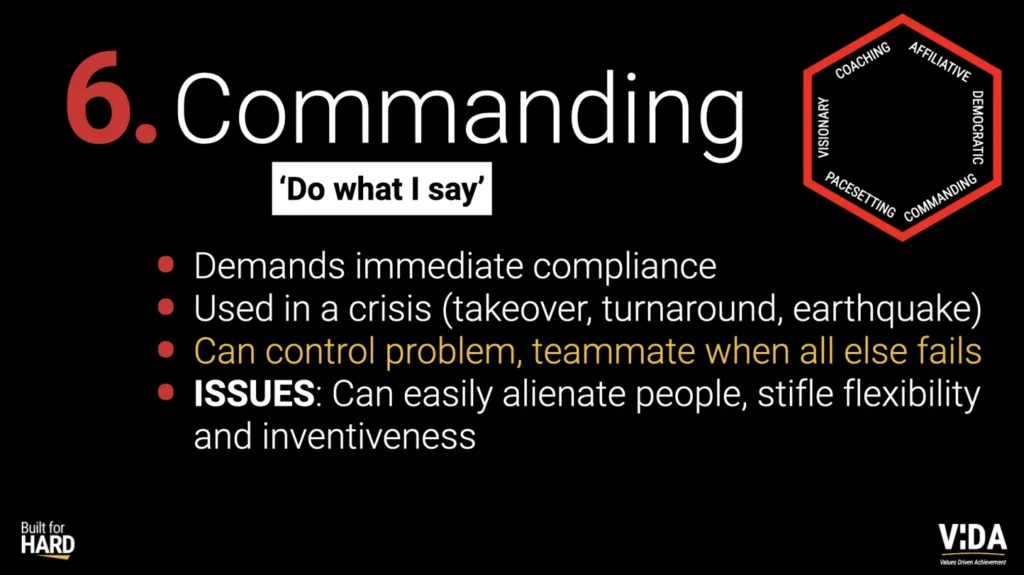
What the moment required was not another developmental conversation.
It required a formal performance plan.
Clear. Written. Time-bound. Delivered in person. With another manager present. No softening that created ambiguity.
The language was simple:
This is what is required. This is the timeline. This is what happens if it does not change.
The coaching distinction was important: commanding from ego is control. Commanding from stewardship is clarity.
This was not about punishing the person.
It was about protecting the business, the team, the standard, and even the underperformer, who deserved to know exactly where they stood.
Avoiding the conversation was not kindness.
It was ambiguity.
Commanding leadership is not control.
Used well, it is clarity in a moment where ambiguity would be irresponsible.
How to build your leadership recipe
Try this exercise.
Write down the six styles:
Visionary.
Coaching.
Affiliative.
Democratic.
Pacesetting.
Commanding.
Now answer these questions.
1. What are your top two default styles?
These are the styles you use without thinking.
2. Which style do you overuse under pressure?
This is usually where your strength starts to leak.
3. Which style does your team need more from you right now?
Not the style you enjoy. The style they need.
4. Which style does your team need less from you right now?
This one can sting. Pay attention.
5. Who on your team needs what?
One person may need coaching.
Another may need clarity.
Another may need belonging.
Another may need a harder standard.
Another may need a decision.
The goal is not to become a different person.
The goal is to become a more useful leader.
A simple leadership style diagnostic
Use this as a quick scan:
But be careful.
The style that is needed in the moment is not always the style that feels best to you.
A pacesetter may think the team needs more urgency when they actually need clearer standards.
A visionary may think the team needs more inspiration when they actually need written accountabilities.
An affiliative leader may think the team needs more support when they actually need a clean conversation about performance.
That is why self-awareness matters.
As the ViDA blog has explored through SCARF, feedback can feel like threat when status, certainty, autonomy, relatedness, or fairness are triggered. Leaders need to pay attention not only to what they say, but to the state they create in the other person.
Leadership range is built under pressure
It is easy to talk about leadership range when everything is calm.
The real test comes when the pressure rises.
When the team misses the target.
When the senior leader challenges your plan.
When the underperformer disappoints you again.
When the room gets tense.
When your body wants to tighten, rush, avoid, rescue, or control.
That is the moment.
You can leak your default style.
Or you can choose.
Take a breath.
Notice the pressure.
Name what the moment requires.
Pick the tool.
Sometimes you need to inspire.
Sometimes you need to listen.
Sometimes you need to coach.
Sometimes you need to decide.
Sometimes you need to protect the relationship.
Sometimes you need to say, clearly and cleanly, “This is what needs to happen next.”
That is not inauthentic.
That is mature.
Final thought
Your default leadership style probably helped you get here.
Respect it.
But do not worship it.
The pacesetter needs to learn how to build capacity, not just output.
The visionary needs to transmit the future, not just see it.
The affiliative leader needs to tell the truth, not just protect the room.
The democratic leader needs to know when the conversation is done.
The commanding leader needs to use authority without becoming addicted to control.
The coach needs to know when the person needs a question and when they need direction.
The world does not need leaders trapped in one style.
It needs stewards with range.
People who can carry pressure without dumping it.
People who can hold standards without becoming harsh.
People who can care deeply without avoiding truth.
People who can move fast without leaving everyone behind.
So ask yourself:
What is my leadership recipe right now?
And maybe more importantly:
What ingredient do I need to add next?
–––––
Adam Kreek and his team are on a mission to positively impact organizational cultures and leaders who make things happen.
He authored the bestselling business book, The Responsibility Ethic: 12 Strategies Exceptional People Use to Do the Work and Make Success Happen.
Want to increase your leadership achievement? Learn more about Kreek’s coaching here.
Want to book a keynote that leaves a lasting impact? Learn more about Kreek’s live event service here.