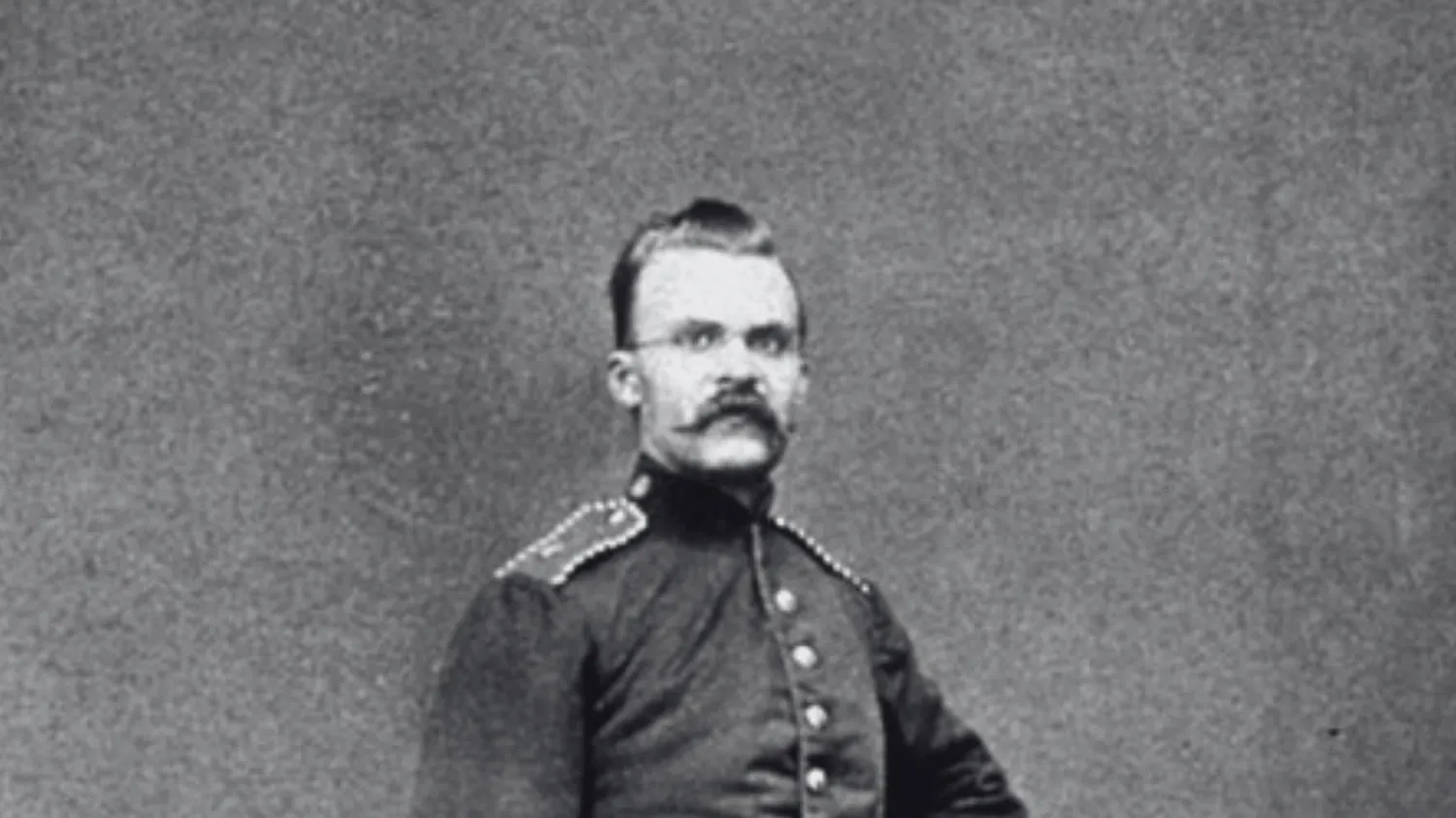
"I tell you: one must still have chaos in one, to give birth to a dancing star."
Fredrich Nietzsche
Philosopher
- Date
Transvaluation of Values: What Trump, Nietzsche and Predictive Index Teach Us About Leadership
posted in Leadership

Adam Kreek
When I’m coaching leaders, we usually don’t start with politics. We start with values. Recently, politics has entered more conversations.
Values are those subconscious emotional drivers that help us make decisions. We inherit them from our families, churches, schools, communities and cultures. As kids, we’re basically handed a values starter-pack and told, “This is what good and bad look like. Off you go.”
At some point, that inherited values bundle stops working.
Mini-Crises and the Transvaluation of Values
As we mature, we hit a series of mini-crises where we realize the values we held as kids don’t fully work for the adult realities we’re facing.
In my own life, I grew up in a very strong religious household. One of the implicit values was: “All gay people are evil. They’re going to hell.” That was just the water I swam in.
Later in life, I realized that value judgment doesn’t work for me. At all.
But that shift wasn’t clean or easy. It felt like betraying my roots, my community, and even myself. It required a full-on transvaluation of values: re-examining what I called “good” and “bad” and updating my internal operating system.
Nietzsche wrote about this process. He argued that we’re born into “herd values”—values of the family, church, state, and institutions. Over time, we can grow beyond them, shedding what doesn’t fit and creating our own. That’s where his idea of the Übermensch comes in: someone who lives entirely by their own values, independent of institutions, traditions or expectations.
In my leadership work, I see this as the point where a person’s inner values escape velocity outstrips the gravity of the system they’re in.
Competing Values in a Polarized Political Landscape
If you’ve read my post on the Competing Values Framework, you’ll recognize some of this. We’re always navigating tensions between:
- Control vs. Change
- Competition vs. Collaboration
- Stability vs. Innovation
In the current political landscape, you can see these values competing in the open.
Historically, Republicans used to be the “conservative” party—control, stability, less change. Now, much of the energy around modern Republicanism (especially in the Trump era) is radically pro-change: disruptive, chaotic, “break things to rebuild them.” Democrats, on the other hand, often behave more like the traditional conservative party—collaborative, stability-focused, protecting norms and institutions.
From a values lens, that’s fascinating. We’ve had a quiet inversion:
- The “conservative” party is now a driver of creative chaos and disruption.
- The “liberal” party has become the guardian of norms, institutions and continuity.
No wonder everyone feels disoriented.
Trump as Übermensch: The Escape Velocity of Values
Nietzsche’s Übermensch is someone who simply does life on their own terms. The church? Irrelevant. The state? Negotiable. Tradition? Optional. Other people’s opinions? Background noise. They’ve reached psychological “escape velocity” and live out their values without asking for permission.
In our era, we see this archetype in public figures:
- Donald Trump
- Jeffrey Epstein
- Elon Musk
- Joe Rogan
Different people, different ethics, same pattern: an intense internal value system that no longer needs to answer to external ones.
Now, I’m not equating their moral worth. I’m pointing to the structure of their relationship to values and power:
- They know (or intuit) what they want.
- They act in service of that, even when it violates longstanding norms.
- They accept—or ignore—the cost: social division, anger, fear, sometimes profound harm.
From a Predictive Index lens (another tool I love and use with clients), you often see:
- Very high Dominance (A): strong advocacy, strong will, insistence on their view.
- High Drive (C): sustained push over time.
- Often high Extraversion (B) and flexibility, and lower empathy.
These psychometric outliers become lightning rods for change. They move systems, not because they’re “good people,” but because they don’t slow down to make everyone comfortable.
The Grotesque Fertilizer of Innovation
There’s a weird paradox here.
The same chaotic, often grotesque energy that leads to social harm also fertilizes innovation. America is a prime example. The chaos—political, cultural, economic—creates incredible suffering and conflict, but that same chaos also generates some of the world’s most powerful innovations.
In Competing Values terms, when you lean hard into:
- Creativity, risk and disruption
- High competition, high stakes, high speed
…you often get:
- Breakthroughs in technology, business and culture
- A lot of people feeling unsafe, unseen or steamrolled
It’s the question I often pose to leaders and teams:
“What are you willing to give up in order to receive?”
Want agility and innovation? You will give up some predictability and calm.
Want stability and cohesion? You will give up some breakthrough inventions and speed.
There is always an opportunity cost.
Hidden Parts of the Iceberg: The Emotional Cost of Values Shifts
In my Leadership Drives Iceberg model, we talk about visible behaviours (above the water) and less visible emotions, values and beliefs (below the water).
Big political shifts—like Trump’s rise, Biden’s tenure, or the whiplash of policy directions every four years—aren’t just about laws and headlines. They’re about what’s happening below the waterline.
When norms are violated repeatedly, people experience:
- Emotional unsettlement
- Confusion about “what’s good” and “what’s bad” now
- A loss of trust in leadership and institutions
We’ve lived through years where:
- One administration practices extreme disruption and competition (“win at all costs”).
- The next administration practices relative inertia, or simply undoes what came before.
The values under the waterline are shifting fast, but our nervous systems, communities and institutions don’t adapt at the same pace. The result is a chronic sense of disorientation.
Leadership Containment: Why Extreme Dominance Needs Boundaries
In my work on Leadership Containment Theory, I argue that strong, driven individuals need firm, clear containers:
- Time limits
- Accountability structures
- Checks and balances
- External constraints on internal intensity
This is especially true for leaders with extreme dominance and drive (think fourth sigma Dominance on Predictive Index—0.1% of the population). When you give that profile too much power for too long, without meaningful accountability, the risk of harm skyrockets.
You see it in:
- Putin: eight early years of “crushing it” by some metrics, followed by entrenched power, and eventually an invasion that’s killed hundreds of children and thousands of civilians in Ukraine.
- Trump: a live experiment in what happens when a system struggles to contain a highly dominant, norm-breaking leader—and what it means when courts and constitutional checks are openly contested.
This is why concepts like peaceful transfer of power and term limits are not just procedural; they’re psychological safety mechanisms for entire nations. They are the container that keeps psychographic outliers from turning into full-blown totalitarians.
Without containment:
- The people who put leaders in power stop being a constraint.
- Approval no longer matters; only the leader’s will does.
- Laws become selectively applied, and “spirit of the law” disappears.
Spirit of the Law, Empathy and the Gray Zones
Personally, I care more about the spirit of the law than the letter of the law. But the spirit of the law only works when you have essentially decent, empathetic people enforcing it. Otherwise, “spirit” becomes an excuse for abuse.
As leaders (and citizens), we have to make peace with gray zones:
- Not everything is black and white.
- People’s experiences and learning journeys matter.
- There must be room for education, growth and nuance.
But—and this is crucial—gray zone thinking requires empathy. When you have leaders who:
- Are psychologically wired for low empathy
- Have escaped the gravity of collective values
- And are structurally unconstrained
…the system is at high risk.
Competing Values Inside Us: Collaboration vs. Competition
I joke sometimes that my Canadianness pulls me toward collaboration and fairness, while my entrepreneurial side whispers, “Channel your inner Trump and extract value. Compete. Win.”
This is the inner Competing Values Framework playing out:
- Collaboration, care, community vs. Competition, extraction, winning
- Stability, control vs. Change, chaos
Both sides are real. Both live in us and in our systems.
The work isn’t to pretend we’re purely collaborative saints. It’s to:
- Get honest about our own values profile (this is where psychometrics like Predictive Index, CliftonStrengths, Working Genius, etc. are so useful).
- Recognize when our competitive or dominant drives are steamrolling others.
- Build containers—personal and systemic—that keep our strength from becoming someone else’s trauma.
Bringing It Back to Your Leadership
So, what do we do with all this?
Name Your Inherited Values
- What did you learn was “good” and “bad” from family, religion, culture?
- Where is that still serving you, and where is it quietly sabotaging you?
Do Your Own Transvaluation
As Nietzsche suggested, your work is to consciously choose your values, not just inherit them. Expect resistance; your nervous system doesn’t love rewriting its core code.
Understand Your Psychometric Profile
Use tools like Predictive Index or Working Genius to see where you are extreme—and where you’re average. If you’re very high in dominance, drive or innovation, you likely need stronger containers around you.
Build Containers Around Your Power
Term limits, advisory boards, clear feedback loops, peer accountability. This is leadership containment: protecting others from your strengths, and protecting you from your own blind spots.
Watch the Waterline
In your team or organization, notice: what’s happening above the water (behaviours) and below (emotions, beliefs, fears)? Political chaos out there often maps to anxiety, conflict and distrust in here.
Where to Go Next on the Blog
If this resonated, you’ll likely enjoy:
- The Competing Values Framework – for a deeper dive on those fundamental tensions in leadership.
- Above and Below the Waterline – to explore how unseen values and emotions shape visible behaviour.
- Leadership Containment Theory – on why strong leaders need strong containers.
- Any pieces where I unpack psychometrics like Predictive Index, CliftonStrengths or Working Genius as practical tools for values-aligned leadership.
Underneath all the noise—in politics, business and our personal lives—values are always driving the show. Our job as leaders is to become conscious of them, choose them wisely, and build containers strong enough to hold the power we’re given.
–––––
Adam Kreek and his team are on a mission to positively impact organizational cultures and leaders who make things happen.
He authored the bestselling business book, The Responsibility Ethic: 12 Strategies Exceptional People Use to Do the Work and Make Success Happen.
Want to increase your leadership achievement? Learn more about Kreek’s coaching here.
Want to book a keynote that leaves a lasting impact? Learn more about Kreek’s live event service here.