"We have a long tradition of developing our leaders to work more effectively as leaders, but we do not have the same tradition of developing specialists to work more effectively as specialists."
Kent Jonasen
CEO Leadership Pipeline Institute
- Date
The Specialist River: Navigating Growth as an Expert
posted in Uncategorized

Adam Kreek
Leadership is not the only river.
For decades, most organizations have built career paths around management. Do good work, become a supervisor. Manage a team, manage managers. Manage managers, lead a function. Lead a function, run a business.
That path matters. We need great leaders.
But what happens to the builder, engineer, analyst, advisor, technologist, scientist, designer, strategist, operator, founder, or craftsperson whose greatest value comes from deep expertise?
Too often, specialists are given a bad choice: become a manager or hit a ceiling.
This is where the Specialist River begins.
The Specialist River is inspired by Kent Jonasen’s Specialist Pipeline, a framework designed to help organizations build a real architecture for specialist performance, development, and career growth. The Leadership Pipeline Institute describes the Specialist Pipeline as a way to map core specialist roles, define the critical transitions between those roles, and clarify the shifts in work values, time application, and skills required at each level.
That language matters.
A specialist career is not simply a longer technical résumé. It is not a reward for being around the longest. It is not a consolation prize for people who do not want to manage.
It is a distinct path of contribution.
The Leadership Pipeline Institute makes the point clearly: in modern organizations, specialist success can no longer be reduced to depth of knowledge alone. Specialists must be able to bring their knowledge into play across the organization.
That is the river.
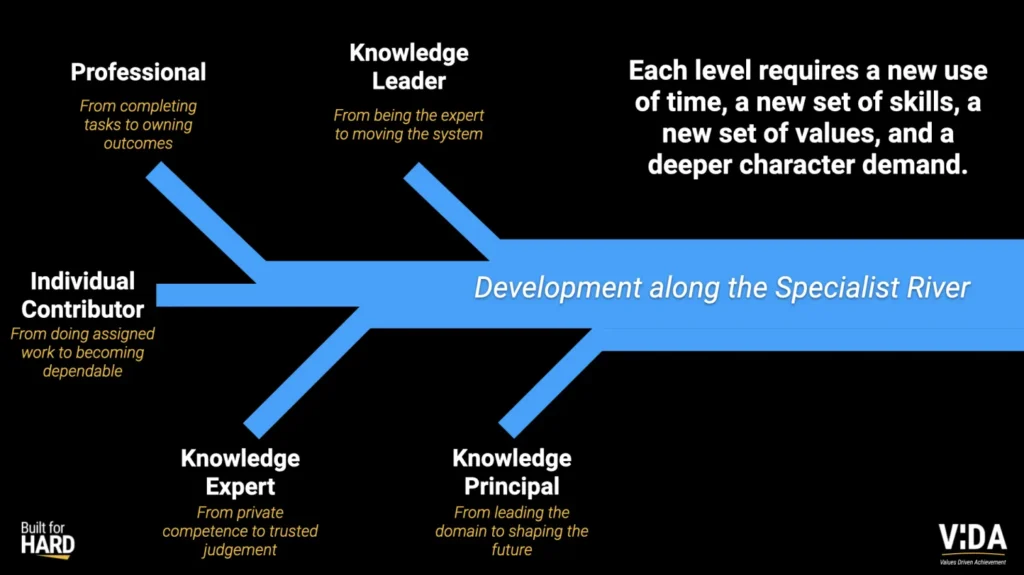
At the beginning, the river is narrow. You learn to do excellent work.
Then it deepens. You become known for judgment.
Then it widens. Your expertise must move through people, teams, and systems.
Finally, the river becomes a watershed. Your expertise starts shaping strategy, risk, innovation, and the future of the organization.
The question is not, “Are you smart?”
The question is, “Can your expertise create value beyond you?”
The River Is Your Guide
In my Leadership River framework, growth as a leader requires a change in time, skills, and values. As responsibility expands, the leader’s boat gets bigger. The work shifts from managing yourself, to managing others, to managing leaders, to managing functions, businesses, groups, and enterprises.
The Specialist River follows the same pattern, but the current is different.
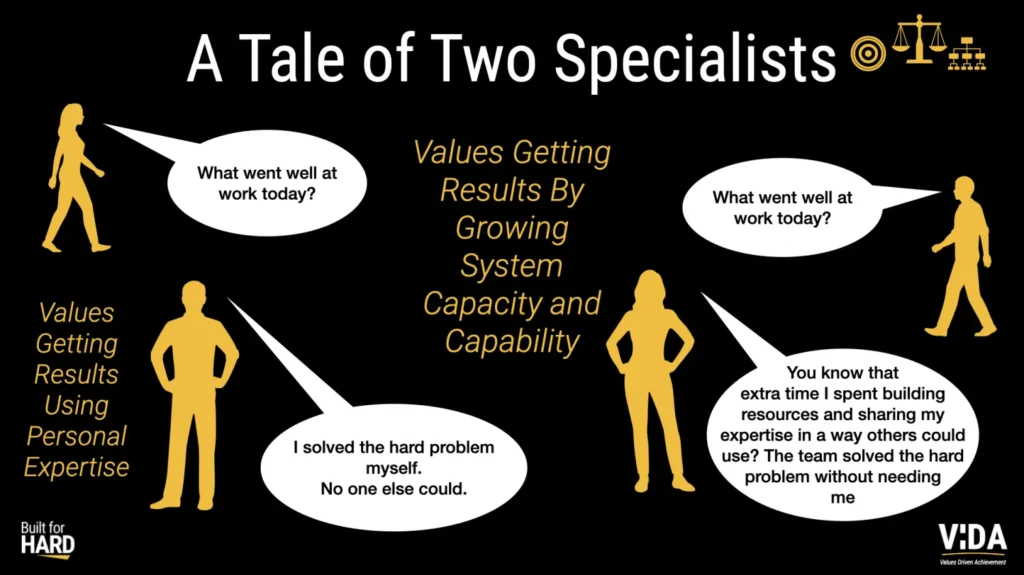
A leader grows by creating results through people.
A specialist grows by creating results through knowledge.
At first, that knowledge lives inside the person. Then it becomes useful to peers. Then it becomes useful across the organization. Eventually, it becomes part of the organization’s strategic advantage.
The Specialist Pipeline commonly describes four specialist levels:
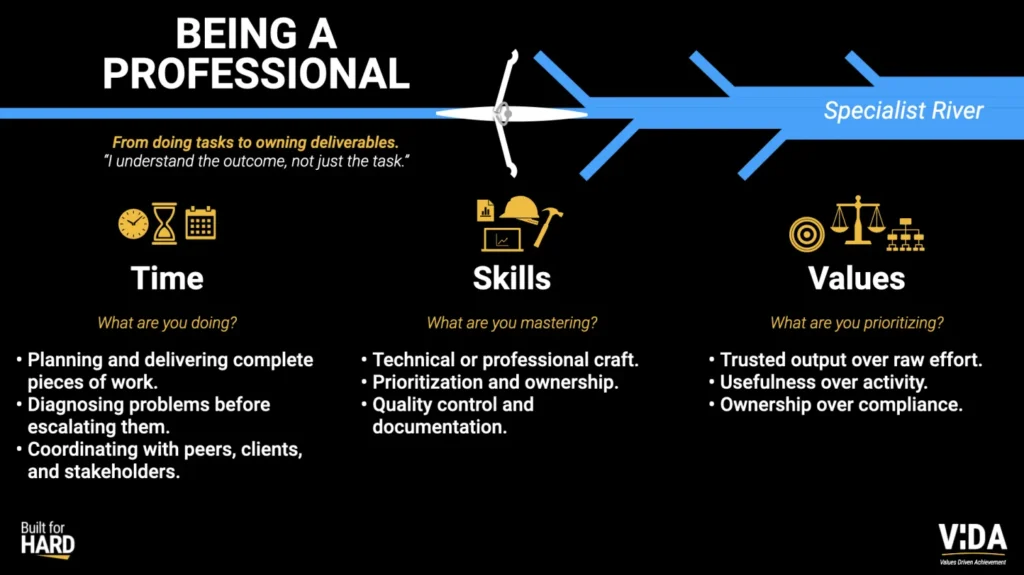
Professional
You deliver reliable, high-quality individual work.
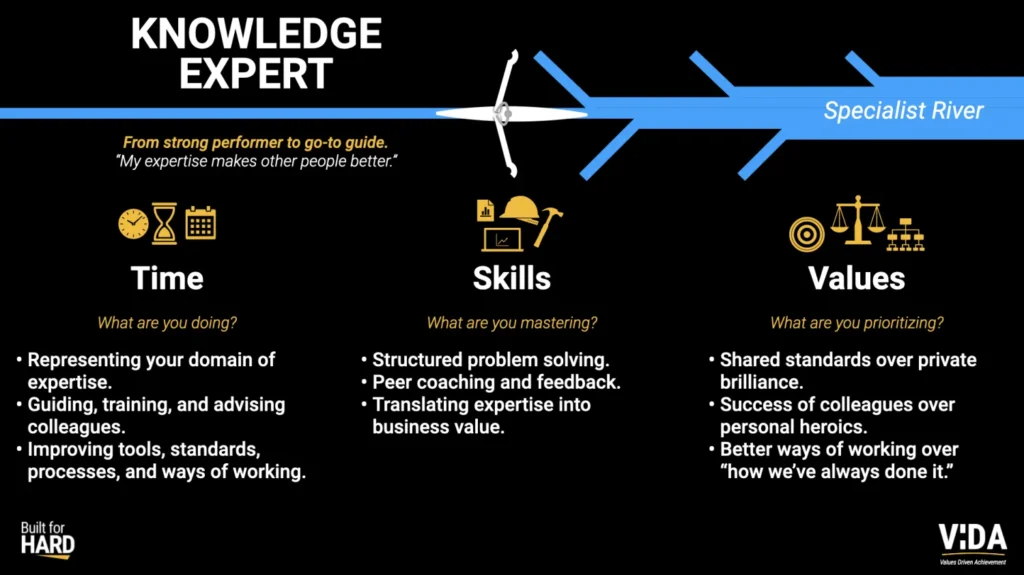
Knowledge Expert
You become a recognized go-to expert who improves tools, processes, standards, and peer capability.
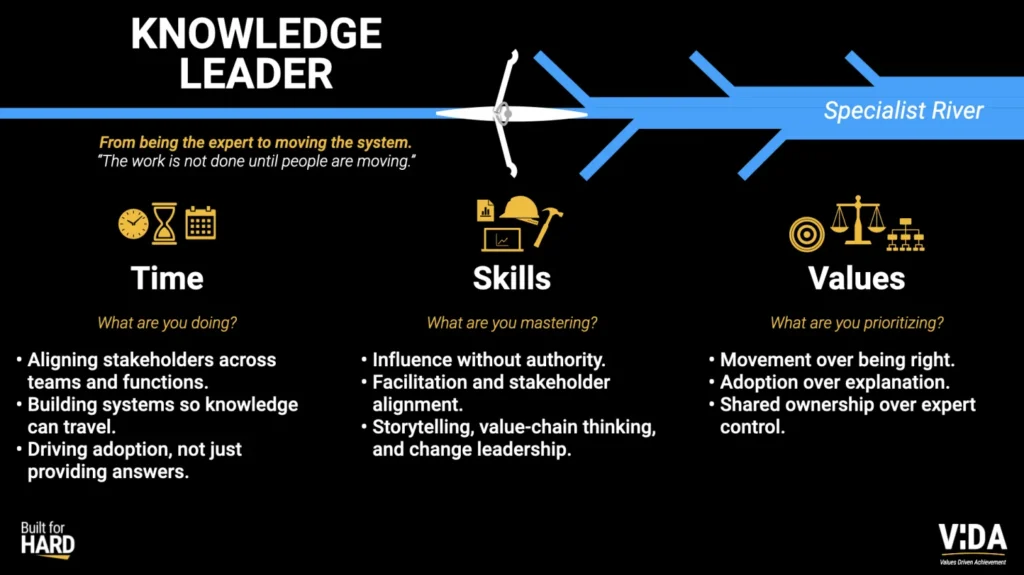
Knowledge Leader
You lead a domain of expertise across teams, stakeholders, functions, or the value chain, often without formal authority.
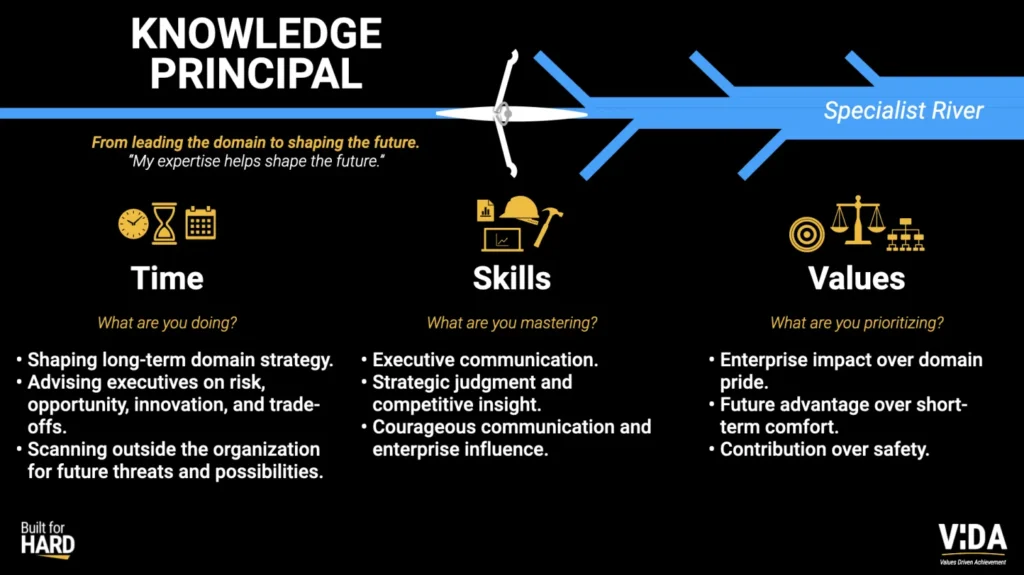
Knowledge Principal
You use deep expertise to shape strategy, innovation, risk, competitive advantage, and the future direction of the organization.
Each level is valuable.
The problem comes when we confuse them.
A strong professional is not automatically a knowledge expert.
A strong knowledge expert is not automatically a knowledge leader.
A strong knowledge leader is not automatically a knowledge principal.
Each passage requires new learning and new behaviour. The Leadership Pipeline Institute warns that each passage represents a major change in job requirements, so the better question is not “Is she a good specialist?” but “Is she a good knowledge expert?” or “Is she a good knowledge leader?”
That is a useful distinction.
Because many talented specialists are not failing. They are simply using yesterday’s success pattern in tomorrow’s role.
The Specialist River Map
Here is the simple version:
The same three questions show up at every stage:
How must I use my time differently?
What skills must I develop now?
What values must I let go of, and what must I learn to value instead?
Setting the Stage: Learning to Learn
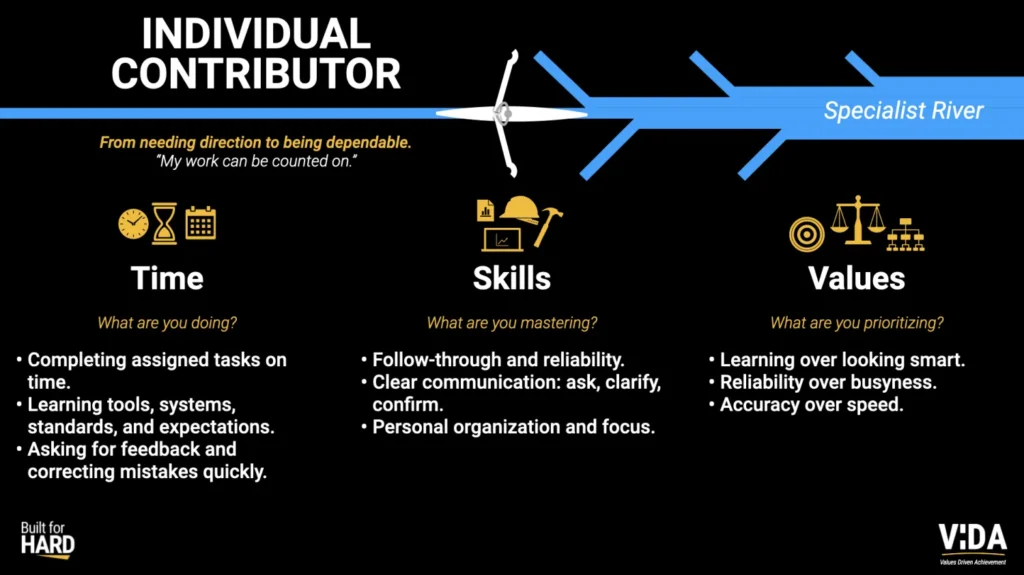
Before someone becomes a professional, they first have to become an individual contributor.
This is the stage before deep expertise. Before strategy. Before being the person others seek out for judgment.
This stage is about learning how to learn.
You learn the tools. You learn the systems. You learn the standards. You learn the expectations. You learn how to ask better questions. You learn how to take feedback without making it a referendum on your worth as a human being.
That last one can take a while.
This is not glamorous work. It is apprentice work.
The individual contributor’s river is narrow, fast, and full of small corrections. The danger is not usually lack of talent. The danger is pretending you already know.
An individual contributor gets into trouble when they value looking smart more than getting better. When they hide confusion. When they wait too long to ask for help. When they think effort alone should earn trust.
The first evolution is simple and hard:
From “Tell me what to do”
to “My work can be counted on.”
This is where reliability begins.
Not heroic reliability. Not “I stayed up until midnight and saved the day” reliability.
Ordinary reliability.
You said you would do it, and you did it. You got stuck, and you asked. You made a mistake, and you corrected it. You received feedback, and the next version was better.
That is how trust starts.
Stage One: The Professional — Learning to Steer Your Own Boat
Learning to be professional is the first step.
This stage is about competence. You learn the craft. You meet deadlines. You produce quality. You build trust. You take feedback. You develop standards. You become someone others can count on.
This is not glamorous work. It is foundational work.
The professional’s river is narrow, fast, and sometimes overwhelming. The danger is not usually strategy. The danger is reactivity.
A professional gets into trouble when every request feels equally urgent, every problem becomes personal, and every task is measured by effort instead of value.
The first evolution is simple and hard:
From “I worked hard”
to “my work can be trusted.”
Professionals must learn to manage their own boat before they try to guide anyone else’s.
That means managing energy, priorities, quality, communication, and commitments. It means understanding not just what the task is, but what decision the task supports. It means developing the discipline to slow down enough to do the work properly.
At this stage, the specialist is not yet the river guide. They are learning how not to capsize.
Passage One: From Professional to Knowledge Expert — Becoming the Go-To Guide
The first real specialist transition is from Professional to Knowledge Expert.
The Leadership Pipeline Institute describes the knowledge expert passage as the first challenging step into a specialist career. It is the transition from being a professional to becoming a knowledge expert who operates effectively in a specialist role.
This is where a person stops being known only for doing good work and starts being known for judgment.
A knowledge expert is the person others seek out.
They see patterns. They improve tools. They raise standards. They train colleagues. They connect technical capability to business results.
The trap at this stage is private excellence.
Private excellence sounds like this:
“I can do it faster myself.”
“No one else understands the details.”
“I’ll just fix it.”
“I built the thing. Isn’t that enough?”
No. Not anymore.
The move from professional to knowledge expert requires the specialist to ask a better question:
What is my expertise for?
Client Story: The Builder Who Forgot to Ask Why
Devlin could build anything.
Hardware, software, automations, integrations — you named the problem, he could engineer a solution. And he did, repeatedly, for years.
He was the person people called when something needed to be figured out. He was genuinely good at it. He took real pride in it. In the culture he came from — technical, rigorous, engineering-first — that was the whole game.
The pattern that cost him was subtle, but consistent:
Idea. Build. Launch. Silence. Move on to the next one.
He had become an expert at solving problems nobody had hired him to solve.
In one of our coaching sessions, he named it himself:
“We got so caught up asking if we could build it, we forgot to ask if we should.”
He wasn’t talking about one project. He was talking about a way of operating that had defined most of his career.
The thing he valued most — the elegance and challenge of the build — had become the thing keeping him stuck.
Meanwhile, his organization had started recognizing his expertise publicly. He was being spotlighted, asked to present, asked to lead thinking on emerging technology. He was standing at the edge of a real transition: from capable professional to recognized expert.
But he did not quite see it yet.
The shift in time was radical for someone who loved building. He needed to spend more time listening and validating before writing a single line of code. Customer conversations first. Prototypes second.
The shift in skills was learning to translate technical capability into business value. Not, “Here is what I built,” but, “Here is the problem this solves, and here is what it costs you to leave it unsolved.”
The shift in values required real work. He had to let go of the intrinsic satisfaction of the craft as the primary reward. The better question was not, “Can I build this well?” It was, “Is this worth building at all?”
The reframe we used was simple: vitamins versus painkillers.
Vitamins are good. People agree they should probably take them. But nobody urgently needs one.
A painkiller is different. When the pain is high enough, people will find a way to pay for it.
Devlin’s work kept landing in vitamin territory: impressive, competent, not urgent.
Once he started leading with the pain — not the solution — things started connecting.
Specialists become experts not when they get better at their craft, but when they learn what their craft is actually for.
Passage Two: From Knowledge Expert to Knowledge Leader — Navigating the Confluence
The second passage is from Knowledge Expert to Knowledge Leader.
This is one of the hardest transitions because the specialist begins to lead without always having formal authority.
The Leadership Pipeline Institute notes that knowledge leaders often report to managers who do not have deep insight into their domain. Their managers depend on them to lead the domain, position it inside the organization, and work independently across the organization.
That is a very different job.
The knowledge expert says, “I know this domain.”
The knowledge leader says, “I can move this domain through the organization.”
At this stage, expertise alone is not enough. The specialist must influence. Convene. Translate. Prioritize. Build alignment. Understand stakeholders. Connect the domain to the value chain.
The river becomes a confluence. Different currents meet:
Technical truth.
Business urgency.
Human resistance.
Customer needs.
Political reality.
Organizational fatigue.
The knowledge leader must navigate all of it.
Client Story: The Whiteboard Genius
Marcus had been the smartest person in every room for twenty years.
Not in an arrogant way — in a useful way.
He could walk into an operational mess, read the system in twenty minutes, and have a diagnosis before most people had finished their coffee. He built his career on that skill.
People trusted him because he was consistently, provably right.
That is a real thing. That matters.
For a long time, it was enough.
Then his scope grew.
Instead of one operation, he was now responsible for aligning multiple organizations around a shared transformation strategy. The people he needed to move were not his direct reports. Some of them had more positional authority than he did. And none of them had time for the full analysis.
He needed a new tool.
What he had was a slide deck: twenty-two slides, dense, thorough, and completely unmovable.
“Put me on a whiteboard with a marker,” he told me in one session, “and I can conduct a symphony. But these slide decks are killing me.”
That line told me everything.
Marcus was still building for the expert in the room — himself.
He was writing the document he would want to receive: complete, rigorous, airtight.
But the room did not need airtight.
The room needed a spark. Something to react to. A frame they could push back on, improve, and ultimately own.
The shift in time was about stopping the loop of perfecting and starting the practice of planting. Less time building the complete case. More time mapping who needed to feel what before the meeting even started.
The shift in skills was learning to lead with the feeling of a problem, not the analysis of it. Shorter decks. Bigger questions. Better rooms. Creating space for smart people to contribute, rather than presenting conclusions for them to receive.
The shift in values was the hardest.
Marcus had to let go of being right as the standard of success.
At this stage, the work is not done when you have solved the problem. The work is done when other people are moving.
When he finally stripped the deck to six slides and opened with the human cost of the status quo — not the data, the cost — the room changed.
People started talking.
They started building with him instead of listening to him.
That is the Knowledge Expert to Knowledge Leader transition.
One person convinces.
The other convenes.
When Expertise Becomes a Bottleneck
The knowledge expert stage feels good.
People need you. People call you. People trust your instincts. You know where the bodies are buried. You can make decisions quickly because you have seen the patterns before.
But there is a danger here.
The indispensable expert can become the ceiling.
This happens in businesses all the time. The founder knows the clients. The senior operator knows the exceptions. The estimator knows the real numbers. The technician knows which workaround actually works. The strategist knows the unwritten rules.
Everyone depends on the expert.
And the expert becomes trapped by their own usefulness.
The move to knowledge leader requires a different instinct.
Not “How do I solve this?”
But “How do I make what I know travel?”
Client Story: The Business in His Head
Every February, the same crisis.
Cash runs thin. The pipeline looks good on paper. The revenue is real. But the free cash is not there. Payroll feels tight. The owner is back in scramble mode — calling in favours, watching accounts, running harder.
The owner I am thinking of had built something genuinely impressive: a multi-location professional services business, grown from nothing, proof of real expertise and real grit.
He knew his field cold.
He knew his clients.
He knew his numbers — roughly, intuitively, in the way you know things when you have been doing something long enough to feel it.
That was exactly the problem.
When I asked him about the business plan for the next three locations he was planning to open, he said:
“I have it in my head.”
I told him I wasn’t buying it.
Not because he was lying. He did have a plan — in the sense that smart, experienced people always have a plan.
But it was a plan nobody else could read, execute, stress-test, or contribute to.
It was brilliant and invisible and completely unscalable.
The shift in time was building in regular structured review — not more hours, but different hours. Time that was not operations, was not client work, was not putting out fires.
Thinking time.
Planning time.
Time to take what lived in his head and put it somewhere it could breathe.
The shift in values required honesty.
The shift in skills meant building the financial and operational literacy to forecast — not to predict the future perfectly, but to create a shared map the team could navigate. It also meant delegation, not just assigning tasks, but genuinely transferring the knowledge that made those tasks make sense.
He had to learn to value predictability as much as freedom.
He had built his business partly on the pleasure of moving fast and trusting his gut. That was a strength. At this scale, it was also a liability.
You cannot grow a business past the size of one person’s working memory.
At some point, the knowledge has to live in the systems, the documents, the meetings, the team — not just in the person who built everything from scratch.
That is the Knowledge Leader move.
Not giving up what you know.
Making sure what you know can travel without you.
Passage Three: From Knowledge Leader to Knowledge Principal — Shaping the Watershed
The third passage is from Knowledge Leader to Knowledge Principal.
At this level, the specialist becomes strategically consequential.
The Leadership Pipeline Institute gives a useful example: in one large company, knowledge principals were identified as some of the most critical people in the organization because losing them would be difficult to recover from and could create a major setback in a key business area.
That is the power of principal-level expertise.
But deep knowledge is not enough.
A Knowledge Principal must be able to navigate at the executive level. LPI notes that senior knowledge principals can get pushed too low in the organization when they are not able to operate at that level, even though the organization needs the specialist voice both vertically and horizontally.
This is the watershed stage.
The specialist is no longer just solving today’s problem. They are helping the organization prepare for tomorrow’s terrain.
The questions change:
Where is our field going?
What risk are we underestimating?
What capability do we need before the market demands it?
What do executives need to understand but cannot see from their altitude?
What future will our current expertise fail to serve?
The Knowledge Principal must turn expertise into strategic contribution.
That requires more than intelligence.
It requires courage.
Client Story: The Leader Nobody Told
Jamie had done a lot of things right.
He had built real relationships, earned real trust, and developed a level of commercial and organizational instinct that most people take decades to grow — if they grow it at all.
He could read a room.
He could see around corners.
He knew his field deeply enough that peers regularly came to him to think things through.
The problem was not competence.
The problem was identity.
We did a 360-degree assessment early in our work together. The gap between how Jamie rated himself and how everyone else rated him was striking.
Not a small gap.
A significant one, across nearly every leadership dimension.
His peers saw someone courageous, ambitious, and ready.
He saw someone still trying not to screw it up.
He said it plainly:
“I have an impostor syndrome at play. They see me as courageous. I see myself as pleasing.”
When I pushed on the pattern, what emerged was consistent.
Jamie was strong and direct with his direct reports.
With his peers, he was inconsistent — sometimes forceful, often deferential.
With people above him, he went quiet.
He waited.
He adjusted his position to match the room.
The feedback from one senior colleague landed hard:
“You don’t need a boss. You need a partner.”
That was the line.
The shift in time meant less energy managing impressions upward and more energy creating clarity for the people around and below him.
Knowledge Principals do not wait for the brief. They shape it.
The shift in skills was courageous communication: learning to say the thing in the room nobody else was saying, not to be provocative, but because that was what the organization actually needed from him.
The shift in values was moving from safety to contribution.
For most of his career, not screwing up had been a reasonable north star. At this stage, it was leaving value on the table.
The organization did not need his compliance.
It needed his perspective.
We made one small agreement. Before every significant meeting, he would ask himself two questions:
What do I actually think about this?
Am I willing to say it?
That practice, repeated consistently over months, changed how he showed up.
Not louder.
More present.
More willing to stand in his own expertise and let others respond to it.
The river does not wait to be given permission to flow.
At some point, you have to stop holding back and let it move.
Why Specialists Get Stuck
Specialists rarely get stuck because they lack intelligence.
They get stuck because they keep using the old success formula after the river has changed.
The professional gets stuck by waiting for instructions.
The knowledge expert gets stuck by hoarding knowledge.
The knowledge leader gets stuck by assuming technical correctness should be enough.
The knowledge principal gets stuck by speaking expert language when the organization needs strategic clarity.
This is why time alone does not solve the problem.
LPI notes that the measurable impact of specialist development does not differ simply based on experience, and that time itself often does not help specialists make the transition. Without support, specialists can return to previous ways of finding success.
That is exactly what I see in coaching.
Capable people hit a passage in the river and interpret the turbulence as personal failure.
“I’m too slow.”
“I’m too much in my head.”
“I’m not strategic enough.”
“I’m not executive enough.”
“I don’t know why people aren’t listening.”
Sometimes, yes, there is a skill gap.
But often the deeper issue is transition.
The old current no longer carries them. The new current requires a different kind of swimming.
That is not failure.
That is growth.
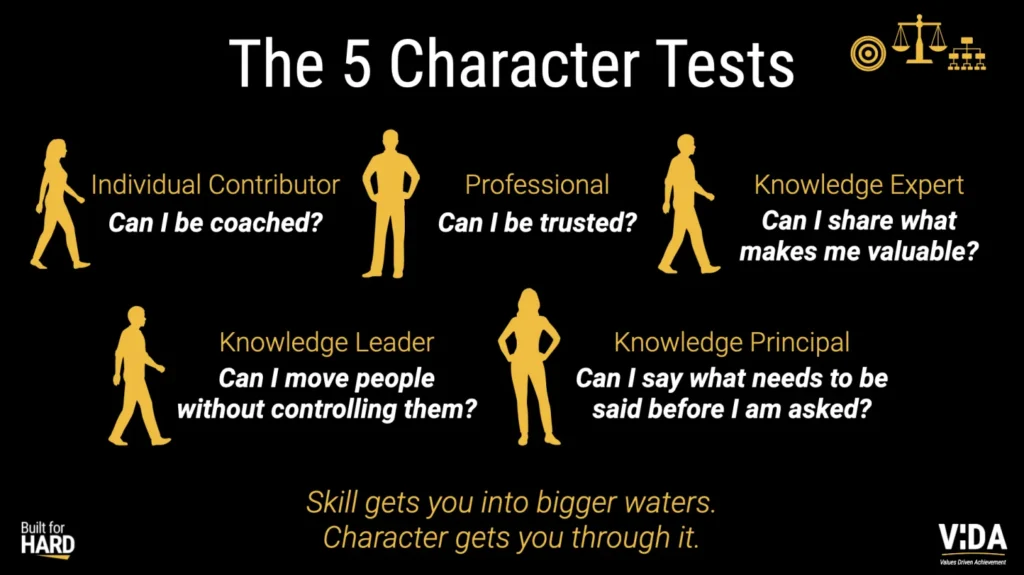
The Evolutions Specialists Need at Each Stage
The Specialist River becomes practical when we look at the required evolution in time, skills, and values.
Professional
Time: Focused execution, prioritization, follow-through, and managing personal energy.
Skills: Technical competence, communication, reliability, documentation, problem solving, and quality control.
Values: Trust, accuracy, accountability, and useful output.
The professional learns to say: “My work can be counted on.”
Knowledge Expert
Time: Less reactive doing. More diagnosis, teaching, improving tools, and connecting expertise to business need.
Skills: Peer coaching, process improvement, technical translation, judgment, feedback, and pattern recognition.
Values: Usefulness over elegance. Shared standards over private brilliance. Business value over technical satisfaction alone.
The knowledge expert learns to say: “My expertise makes other people better.”
Knowledge Leader
Time: Less time perfecting the answer alone. More time aligning stakeholders, shaping conversations, and building systems where expertise can travel.
Skills: Influence without authority, facilitation, stakeholder mapping, change leadership, value-chain thinking, and storytelling.
Values: Movement over being right. Adoption over explanation. Shared ownership over expert control.
The knowledge leader learns to say: “The work is not done until people are moving.”
Knowledge Principal
Time: Less time in immediate delivery. More time on strategy, external scanning, executive alignment, future risk, and capability building.
Skills: Strategic communication, executive presence, innovation leadership, competitive analysis, courageous communication, and mobilizing people around future solutions.
Values: Contribution over safety. Future advantage over short-term comfort. Strategic clarity over technical completeness.
The knowledge principal learns to say: “My expertise must help shape the future.”
Practical Application for Specialists
Use the Specialist River as a self-assessment.
If you are a Professional, ask:
- Can people trust my work without rechecking it?
- Do I understand what decision my work supports?
- Am I managing my own time, energy, and commitments?
If you are a Knowledge Expert, ask:
- Do others seek my judgment?
- Am I improving the tools, standards, and processes around my domain?
- Am I teaching others, or just rescuing them?
If you are a Knowledge Leader, ask:
- Can I move my expertise across teams and stakeholders?
- Can I influence without formal authority?
- Can I help others own the solution, or do I need to be the smartest person in the room?
If you are a Knowledge Principal, ask:
- Am I helping the organization see the future?
- Can I communicate my expertise at the executive level?
- Am I willing to say what I actually think when the room needs my perspective?
Practical Application for Organizations
For organizations, the Specialist River asks a sharper question:
Are you developing specialists with the same seriousness that you develop leaders?
Many organizations say specialists matter. Fewer build the architecture to support them.
LPI argues that specialists need visible career paths, performance standards, development programs, and a real alternative to choosing the leadership track.
That is not an HR nicety. It is a business issue.
When you do not develop specialists, you create predictable risks:
- Critical knowledge lives in one person’s head.
- Experts leave because management is the only visible path.
- Technical people become managers when they should have become stronger specialists.
- Managers evaluate specialists with leadership tools that do not fit the job.
- Strategic decisions are made without the people who understand the domain deeply enough.
The Specialist Performance Index makes this point in another way: specialists should be assessed against the actual job that needs to be done, not against generic leadership competency models repurposed for specialist roles.
That distinction matters.
A specialist is not a leader without direct reports.
A specialist is a value creator with a different job to do.
When Your Business Is Smaller
In small and medium-sized businesses, one person may need to hold several stages of the Specialist River at once.
The founder may still be the professional doing the work.
They may also be the knowledge expert everyone calls for judgment.
They may also be the knowledge leader trying to get the team to use repeatable systems.
And, on their best days, they may be the knowledge principal thinking about the future of the market.
This compression creates pressure.
- It is why the owner says, “I have it in my head.”
- It is why the technical founder keeps building before validating.
- It is why the senior expert keeps fixing problems instead of teaching others how to prevent them.
- It is why the strategic specialist waits for permission from executives who actually need their perspective.
- Small businesses do not always need more hierarchy.
- Often, they need expertise to become transferable.
They need the river to keep moving after the founder, expert, or senior operator leaves the room.
Final Thought
A specialist career is not a backup plan.
It is not the path for people who “couldn’t” become managers.
It is a powerful and necessary path of contribution.
At each passage, the specialist must let go of a smaller identity.
From “I do good work.”
To “I am the expert.”
To “I lead the domain.”
To “I shape the future.”
The river keeps asking for a new kind of maturity.
The Professional learns reliability.
The Knowledge Expert learns usefulness.
The Knowledge Leader learns movement.
The Knowledge Principal learns courage.
The deeper your expertise, the greater your responsibility to make it useful to others.
That is the Specialist River.
Not knowledge for status.
Knowledge in motion.
Knowledge that teaches.
Knowledge that travels.
Knowledge that shapes better decisions.
Knowledge that helps the organization navigate what comes next.
Specialist growth is not about knowing more. It is about carrying what you know farther.
credit note
This article builds on Kent Jonasen’s Specialist Pipeline and the Leadership Pipeline Institute’s public materials on specialist development. The Specialist River metaphor adapts those ideas into a coaching framework for expert growth, using anonymized stories from ViDA coaching work.
–––––
Adam Kreek is on a mission to positively impact organizational cultures and leaders who make things happen.
Kreek is an Executive Business Coach who lives in Victoria, BC, near Vancouver, British Columbia, Canada, and Seattle, Washington, USA, in the Pacific Northwest. He works with clients globally, often travelling to California in the San Francisco Bay Area, Atlanta, Georgia, Toronto, Ontario and Montreal, Quebec. He is an Olympic Gold Medalist, a storied adventurer and a father.
He authored the bestselling business book, The Responsibility Ethic: 12 Strategies Exceptional People Use to Do the Work and Make Success Happen.
Discover our thoughts on Values here.
Want to increase your leadership achievement? Learn more about Kreek’s coaching here.
Want to book a keynote that leaves a lasting impact? Learn more about Kreek’s live event service here.