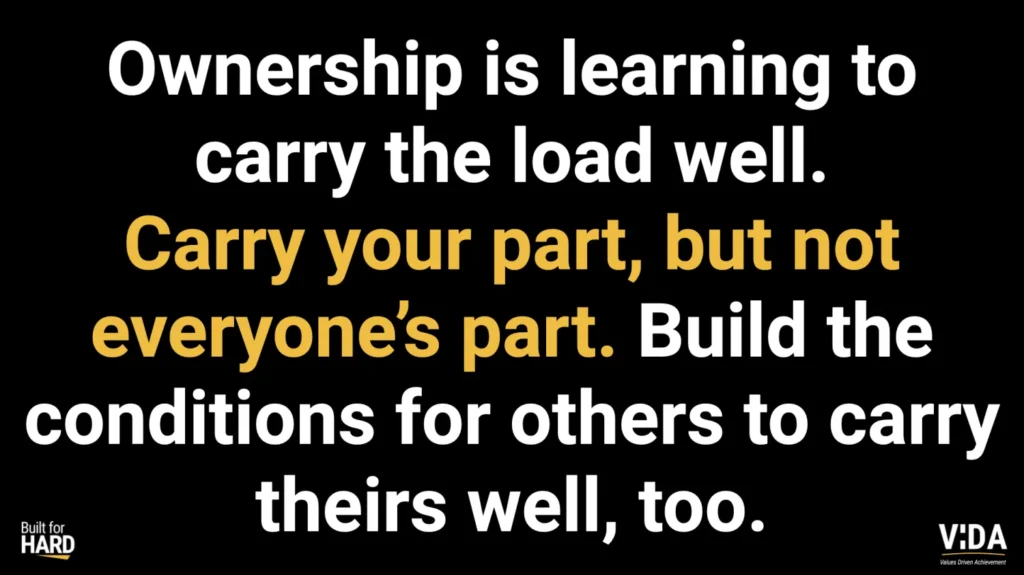
"Ownership is learning to carry the load well, but that's not all..."
Adam Kreek
Founder Built for Hard
- Date
Thank You, Associated Engineering — Building Ownership Under Pressure
posted in Past Presentation Slides
Adam Kreek
Thank you to everyone at Associated Engineering who joined me for our recent keynote: Building Ownership: Carry the Load Well.
I’m grateful for the energy, reflection, and honesty in the room. You are working inside a complex, high-responsibility environment where quality matters, clients matter, technical excellence matters, and the way people carry pressure together matters.
The keynote was not about adding another slogan to the wall.
It was about asking a more useful question:
What does ownership actually look like when pressure rises?
At AE, ownership is already part of the language: taking responsibility for the work and committing to every project as if you are its owner. In the keynote, we explored how that value becomes visible in real behaviour — in communication, trust, follow-through, care, accountability, and how leaders help others carry their part of the load.
You can download the slides, worksheet, survey questions with audience-response summary below.
Slide PDF link
Worksheet link
Survey response summary
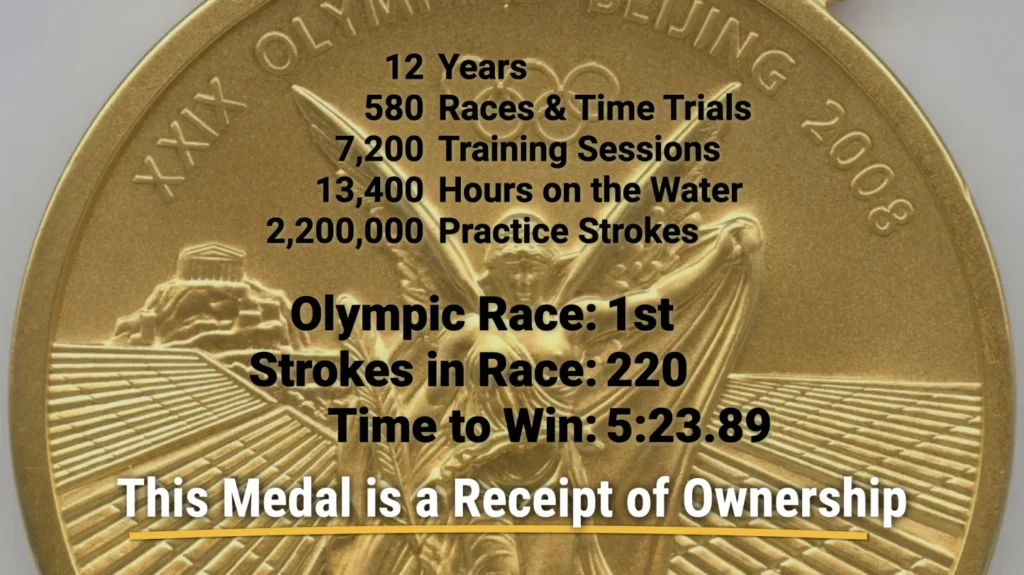
1) The medal is a receipt of ownership
We started with the Olympic gold medal.
Not as a symbol of glory. As a receipt.
A receipt for 12 years of training, 580 races and time trials, 7,200 training sessions, 13,400 hours on the water, and more than 2.2 million practice strokes. It was also a receipt for the harder numbers: a choked Olympic final, herniated discs, lost training days, failed sessions, and millions of imperfect strokes.
Ownership is rarely one dramatic moment.
It is repeated reps in service of a bigger strategy (as described with more applicable context when we talk about the 4HAG method, project launches and strategic planning.)
The medal becomes a metaphor, a touch point, a reminder of the quiet decisions we make to care about the quality of our work, the people beside us, our client relationships, and the future we are building.
2) Carry the load well
One of the central stories was The Log.
The lesson was simple:
Same log. Different load. Better position. Farther together.
Sometimes the load is obvious: the deadline, the deliverable, the client issue, the technical problem, the project pressure.
Sometimes the heavier load is less visible: the story someone is carrying, the pressure they are under, the uncertainty they feel, or the trust that has not yet been built.
That is why ownership is not just carrying more.
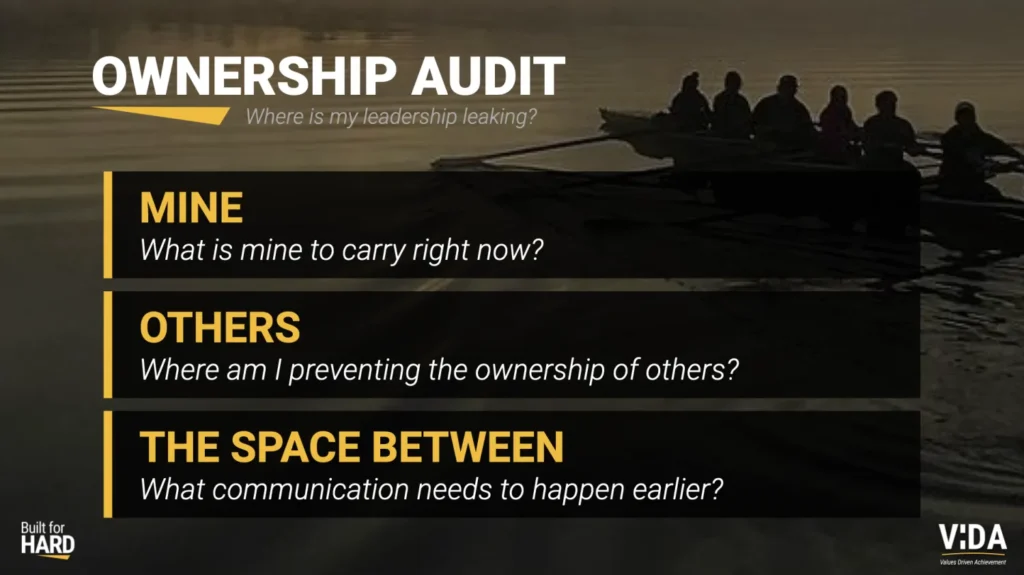
Ownership is learning:
- what is mine to carry
- where I may be carrying too much
- where I may be preventing others from carrying their part
- what communication needs to happen earlier
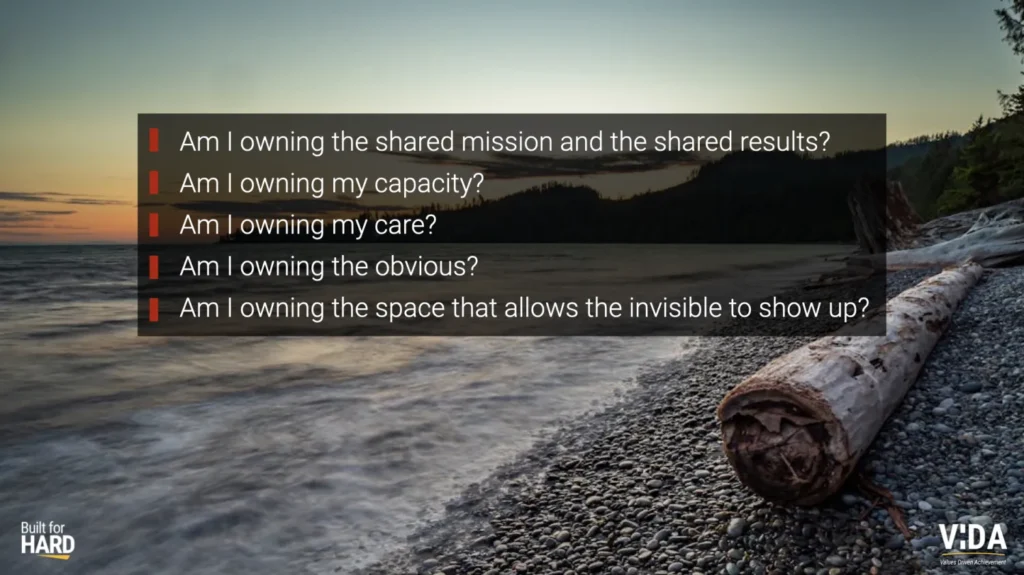
That became one of our key ownership questions:
What is mine to carry right now?
3) Responsibility is taken. Blame is placed.
We then moved into The Responsibility Ethic.
Responsibility is not guilt. It is not shame. It is not blame.
Those usually come for free.
Responsibility is different. Responsibility is the ability to choose your response.
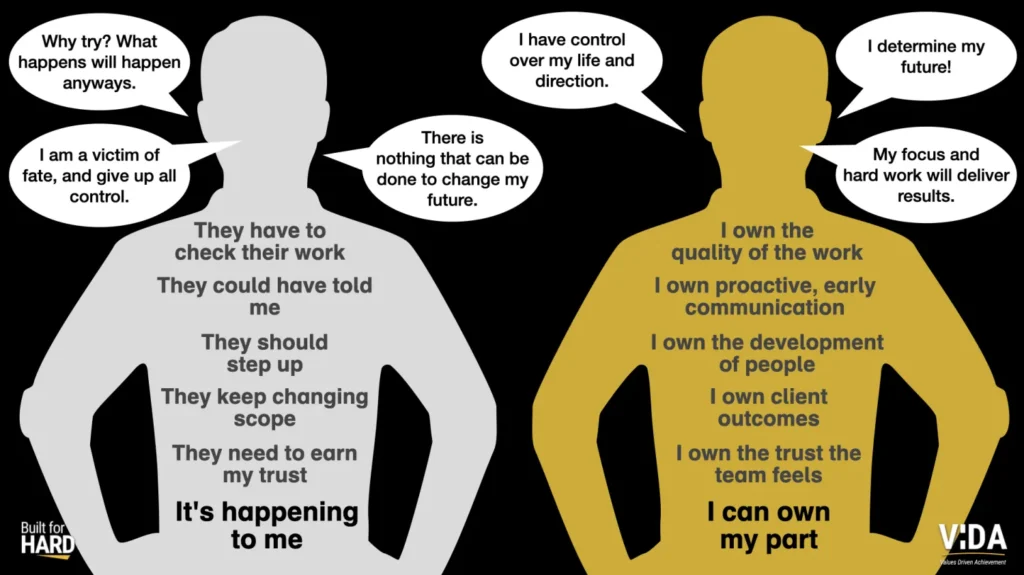
When pressure rises, it is easy to slip into “they should” language:
- They should have told me.
- They should step up.
- They need to earn my trust.
- They keep changing scope.
- They have to check their work.
Some of those statements may even be true.
But ownership asks a better question:
What part of this is mine to own?
That shift matters because blame often freezes improvement. Responsibility creates movement.
4) From personal ownership to shared ownership
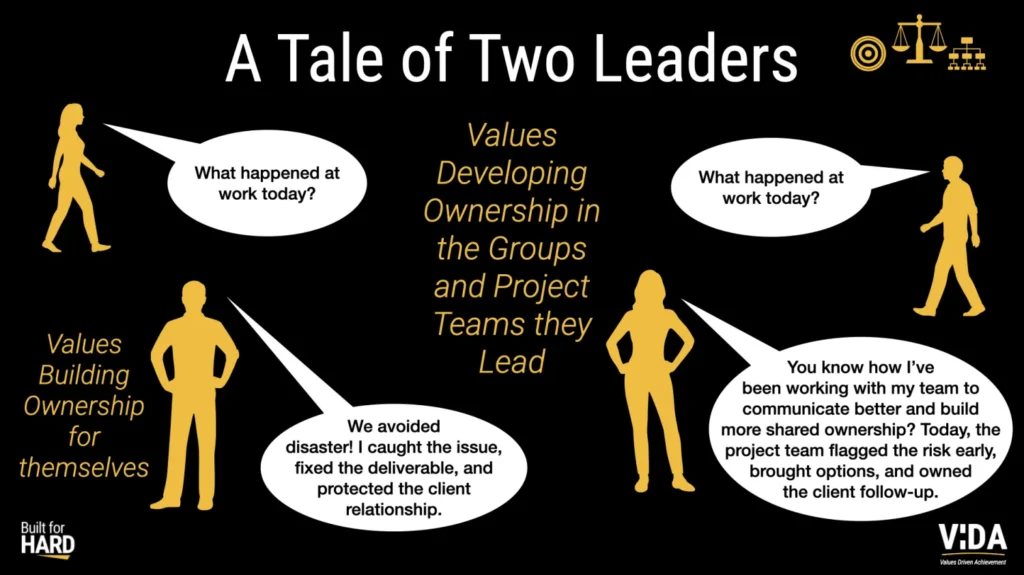
A big theme of the keynote was the difference between personally owning the work and building ownership in others.
Both matter.
But as leadership responsibility grows, the work changes.
The goal is not to become the person who owns everything.
The goal is to build teams where ownership moves.
That means helping people:
- understand the standard
- speak up earlier
- bring options
- own follow-through
- close the loop
- protect the client relationship
- build trust with one another
In the language of the keynote:
Own your part. Help others own theirs. Keep the load moving.
5) Ownership needs grit and grace
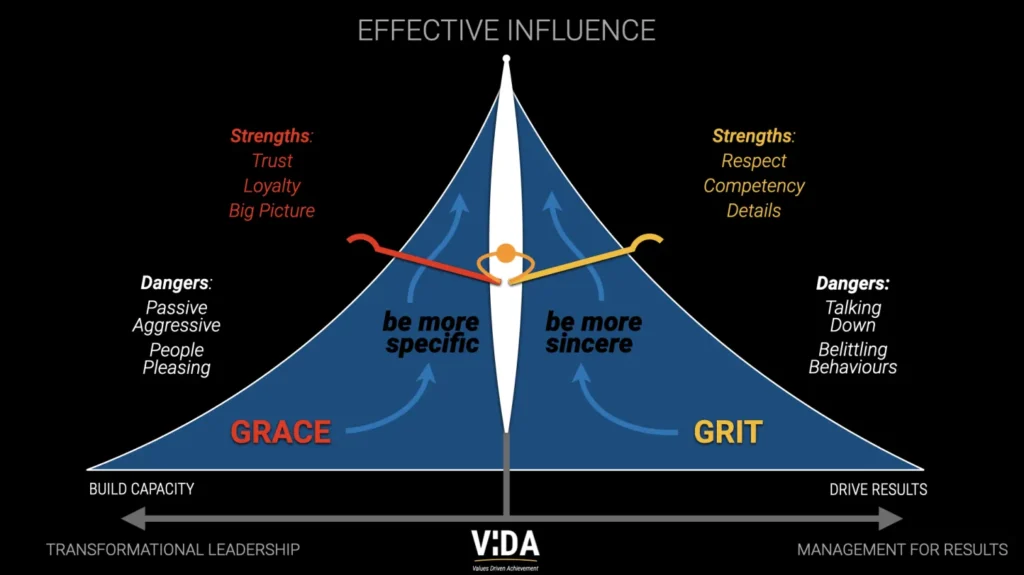
Ownership under pressure requires both grit and grace.
Grit helps us face reality, hold standards, follow through, and do the hard thing.
Grace helps people stay open, supported, trusted, and willing to learn.
Too much grit without grace can create fear, control, and unnecessary damage.
Too much grace without grit can become avoidance, people-pleasing, or lowered standards.
The stronger question is:
Does this moment ask for more grit or more grace from me?
That is a practical leadership question I write more about on this blog. It helps us choose the right part of ourselves for the right room.
6) Protect the people, the work, and the trust
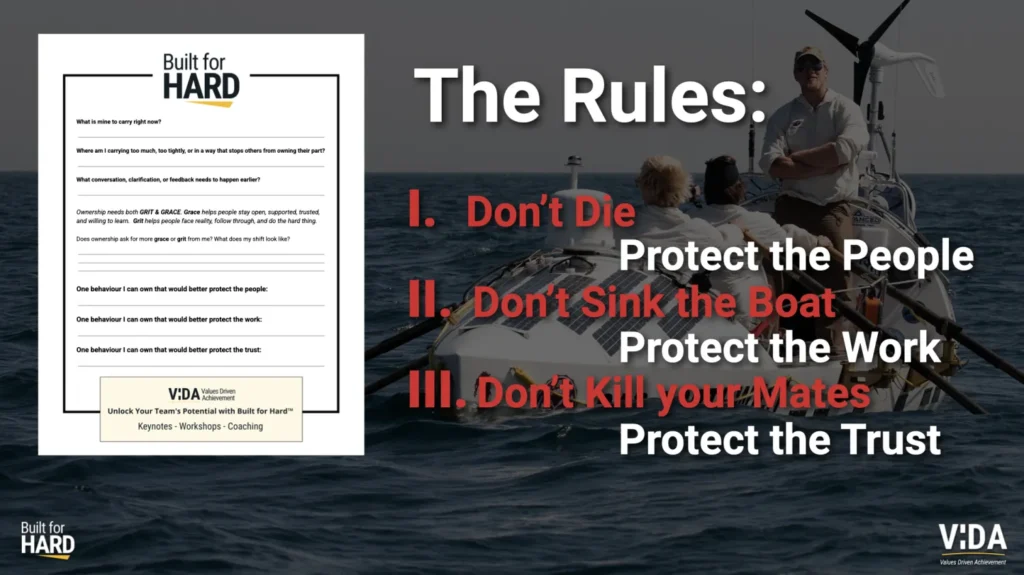
From the ocean-row story, we translated three simple boat rules:
- Don’t die.
- Don’t sink the boat.
- Don’t kill your mates.
Into a leadership frame:
Protect the people.
Protect the work.
Protect the trust.
That is a useful ownership test.
When pressure rises on a project, ownership is not just about getting the deliverable out the door.
It is also about how we treat people, how we protect quality, and whether trust is stronger or weaker after the hard moment passes.
7) What the audience responses told us
Thank you to everyone who contributed to the live survey responses. Your words created a useful picture of where ownership is already strong at AE and where there is room to strengthen the culture.
When asked:
What is one ownership behaviour we should practice more consistently at AE?
The clearest pattern was communication.
People named the need for earlier, clearer, more honest, and more consistent communication. They also named trust, listening, support, care, empathy, grace, accountability, recognition, collaboration, feedback, empowerment, and follow-through.
In plain language:
People want ownership to show up through clearer communication, stronger trust, and better follow-through.
When asked:
When pressure rises on a project, what does that look like in the teams at AE?
The answers showed two sides of the culture.
On the strong side, people described teams that rally, support one another, focus, step up, and work hard to deliver.
On the risk side, people also named stress, blame, panic, silence, siloing, shorter fuses, rushed decisions, and communication breakdowns.
That does not mean AE lacks ownership.
It means pressure reveals where ownership is strong and where ownership needs stronger habits.
The opportunity is to make the best of AE more consistent under pressure:
- flag risks earlier
- bring options
- clarify expectations
- name who owns what
- close the loop
- protect quality
- make truth easier to tell
- support people while still holding the standard
8) Keep going: one behaviour this week
The keynote was not meant to end in the room.
Pick one behaviour and practice it this week.
Try one of these:
- Flag a risk earlier.
- Bring two options instead of only naming a problem.
- Clarify what “done” looks like.
- Close the loop after a decision.
- Ask, “What is mine to carry right now?”
- Ask, “Where am I preventing someone else from owning their part?”
- Protect the people, the work, and the trust.
Ownership is care made visible through action.
Not theory. Not slogans. Not perfect intentions.
Action.
Your next ownership move
AE is full of people who care deeply about technical excellence, client service, project outcomes, and each other.
The next step is to make that care more visible and more consistent under pressure.
So ask yourself:
What is mine to carry right now?
Where do I need to help others own their part?
What communication needs to happen earlier?
Thank you again to the Associated Engineering team for the opportunity to row alongside you for a short stretch.
You are doing meaningful work.
Keep carrying the load well.
–––––
Adam Kreek and his team are on a mission to positively impact organizational cultures and leaders who make things happen.
He authored the bestselling business book, The Responsibility Ethic: 12 Strategies Exceptional People Use to Do the Work and Make Success Happen.
Want to increase your leadership achievement? Learn more about Kreek’s coaching here.
Want to book a keynote that leaves a lasting impact? Learn more about Kreek’s live event service here.