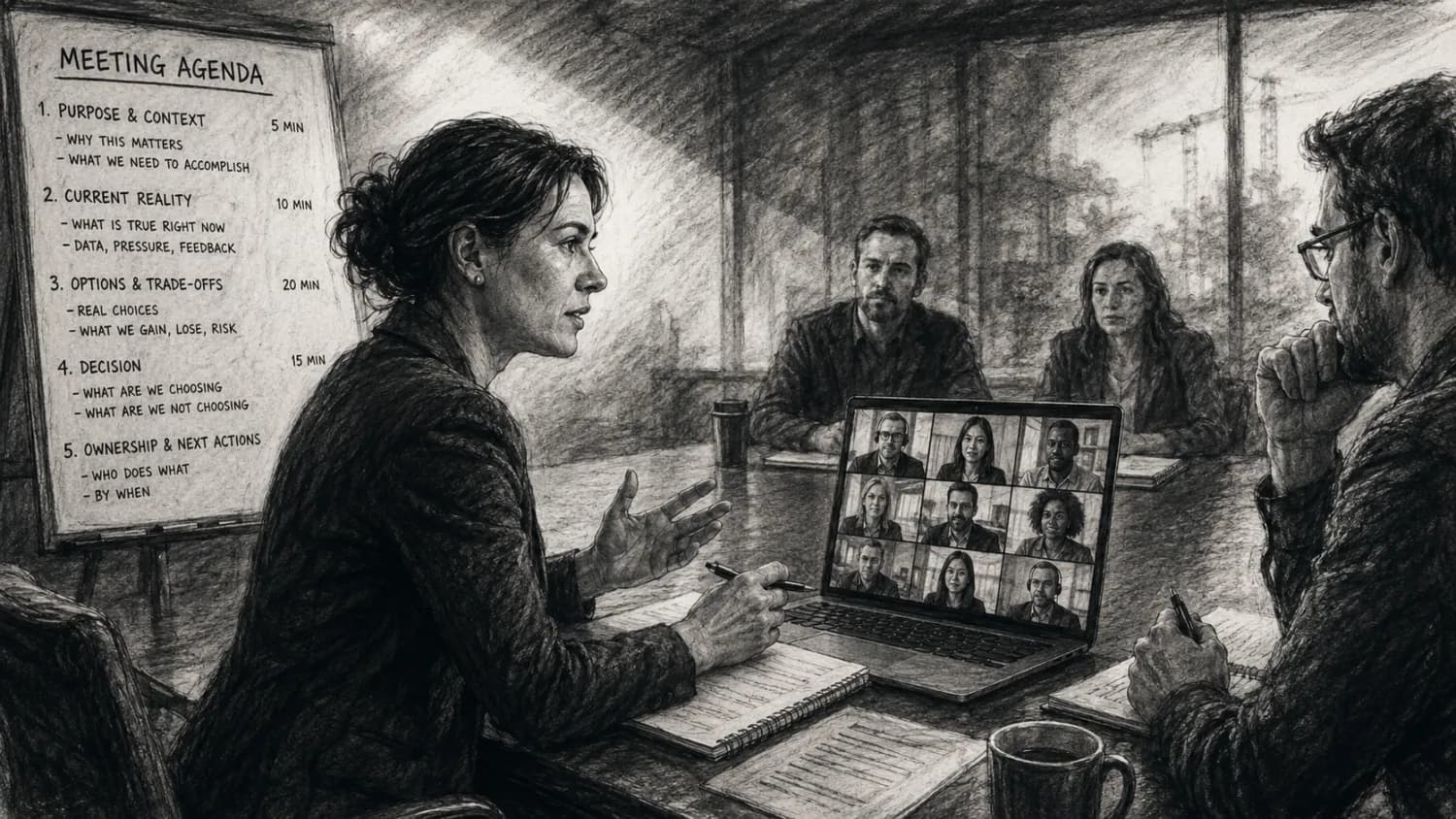
"No agenda? No attend-a..."
Adam Kreek
Founder Built for Hard
- Date
Meet Better: The POAD Framework for Meetings That Actually Move Work Forward
posted in Uncategorized

Adam Kreek
Most bad meetings do not fail because people are lazy.
They fail because the meeting has no container.
No clear purpose.
No useful outcome.
No real agenda.
No decision path.
So people show up, talk in circles, drift into updates, chase side issues, avoid the hard thing, and leave with a vague sense that something happened.
But nothing moved.
That is expensive. Not just financially. It costs attention, energy, trust, momentum, and leadership credibility.
Microsoft’s Work Trend Index found that people rank inefficient meetings as the number one disruptor to productivity, with unclear next steps at the end of meetings also showing up as a major pain point. Atlassian reported a similar pattern: many workers leave meetings without a clear idea of next steps or who owns which task. Harvard Business Review has made the same basic point from another angle: meetings can be useful spaces to investigate issues, explore possibilities, and agree on action, but only when they are designed with intention.
The problem is not meetings.
The problem is uncontained meetings.
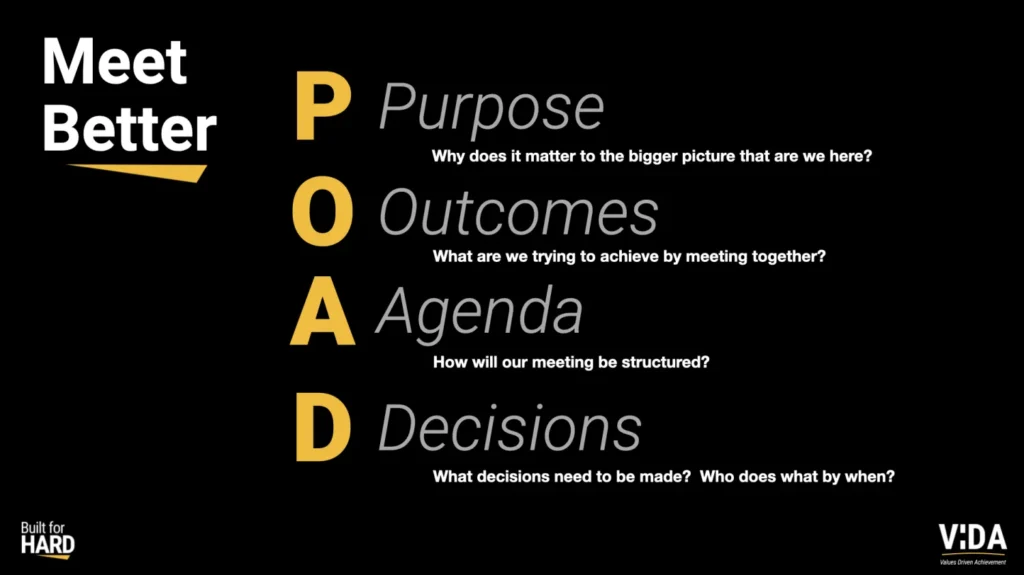
That is why I use POAD.
POAD is a simple meeting framework:
Purpose
Outcomes
Agenda
Decisions
Four words. Four questions. One better container.
P — Purpose
Why does this matter to the bigger picture?
Purpose is not the topic.
“Marketing update” is not a purpose.
“Leadership team meeting” is not a purpose.
“Budget review” is not a purpose.
Those are labels.
Purpose answers the question: Why are we here, and why does this matter now?
A stronger purpose sounds like this:
“We are meeting to align our marketing priorities because our team is spread too thin, and we need to focus our energy on the channels most likely to drive qualified leads this quarter.”
That is different.
Now people know why the conversation matters. They understand the stakes. They can connect the meeting to strategy, pressure, customer value, team health, or performance.
Purpose gives the meeting moral weight.
Without purpose, the conversation drifts.
With purpose, people can aim.
Before you call a meeting, ask:
- Why does this matter?
- What bigger goal does this serve?
- What pressure, risk, opportunity, or responsibility makes this worth our time?
- What happens if we do not meet?
If you cannot answer those questions, you may not need a meeting.
You may need an email.
A video update.
A decision memo.
A phone call.
Or a walk around the block to think before you pull six people into a room.
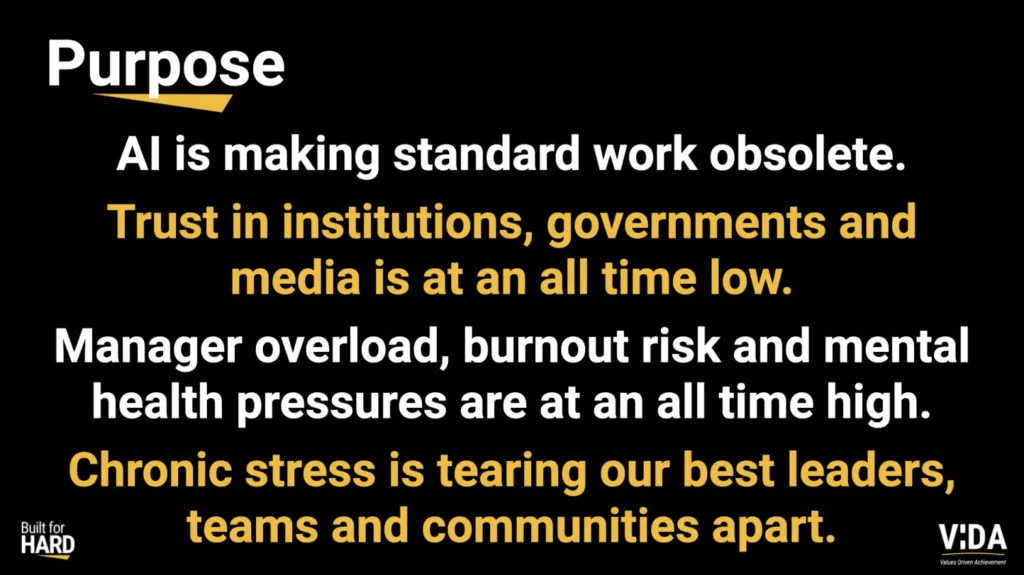
O — Outcomes
What are we trying to achieve by meeting together?
Outcomes are different from topics.
A topic is what you talk about.
An outcome is what changes because you talked.
Most meetings have too many topics and too few outcomes.
That is why they feel busy but weak.
A useful outcome starts with:
By the end of this meeting, we will have…
For example:
By the end of this meeting, we will have:
- A clear decision on the top three priorities for the next 90 days.
- A shared understanding of the biggest barrier slowing the team down.
- A draft plan for who owns what by Friday.
- A stronger understanding of the trade-offs between option A and option B.
- A clear recommendation to bring to the board.
Good outcomes create tension.
Not emotional tension. Productive tension.
They make it obvious when the meeting is working and when it is not.
If the outcome is clarity, you can ask: “Are we clearer?”
If the outcome is a decision, you can ask: “Have we decided?”
If the outcome is alignment, you can ask: “Are we actually aligned, or are we politely nodding?”
Outcomes turn meetings from theatre into work.
A — Agenda
How will our meeting be structured?
An agenda is not a decorative list.
It is a path.
Harvard Business Review notes that a well-designed agenda sets expectations, helps people prepare, allocates time wisely, keeps people on the same topic, and helps identify when a discussion is complete.
That sounds basic because it is basic.
But basic does not mean easy.
A poor agenda says:
- Updates
- Discussion
- Next steps
That is not an agenda.
That is a hope.
A stronger agenda says:
- Purpose and context — 5 minutes
Why this matters and what we need to accomplish. - Current reality — 10 minutes
What is true right now? What data, pressure, or feedback do we need to face? - Options and trade-offs — 20 minutes
What are the real choices? What do we gain, lose, risk, or protect? - Decision — 15 minutes
What are we choosing? What are we not choosing? - Ownership and next actions — 10 minutes
Who does what by when?
That agenda contains the meeting.
It protects the group from wandering.
It protects the introverts from being steamrolled.
It protects the decision from being buried.
It protects the leader from pretending that a messy conversation was a productive one.
Structure is not bureaucracy.
Structure is kindness.
Clear is kind.
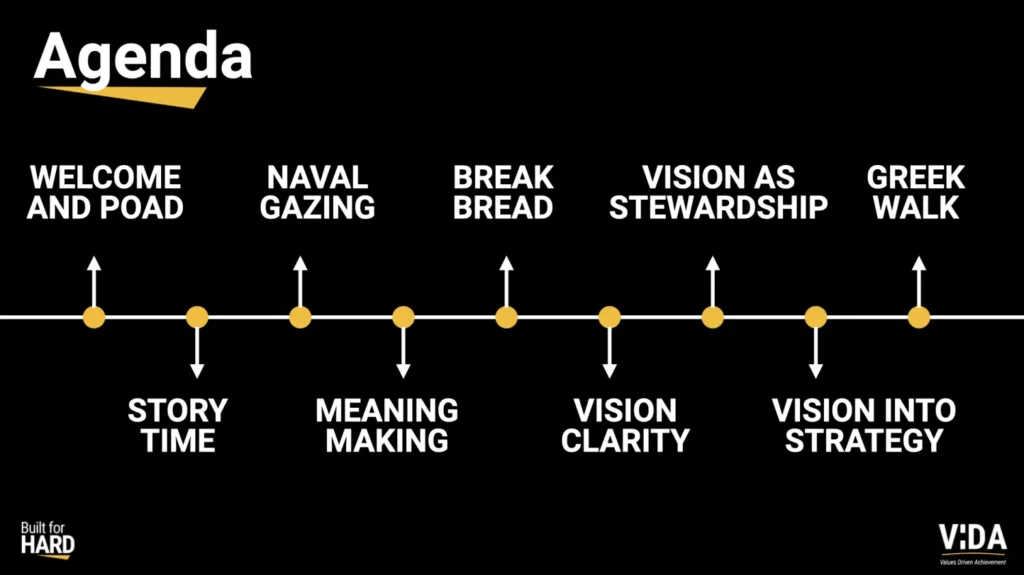
D — Decisions
What decisions need to be made? Who does what by when?
This is where many meetings fail.
The conversation may be interesting.
The group may be engaged.
The ideas may be useful.
But if nobody decides, owns, or acts, the meeting becomes a very expensive campfire.
Warm. Familiar. Occasionally meaningful.
But not enough.
Every meeting should end with some version of:
What did we decide?
What did we not decide?
Who owns the next step?
By when?
How will we know it happened?
Who else needs to know?
Not every meeting needs a massive decision.
Some meetings are for sense-making.
Some are for relationship.
Some are for surfacing reality.
Some are for preparing a future decision.
That is fine.
But even then, you should decide what happens next.
A meeting without a decision can still be useful.
A meeting without any movement is usually waste.
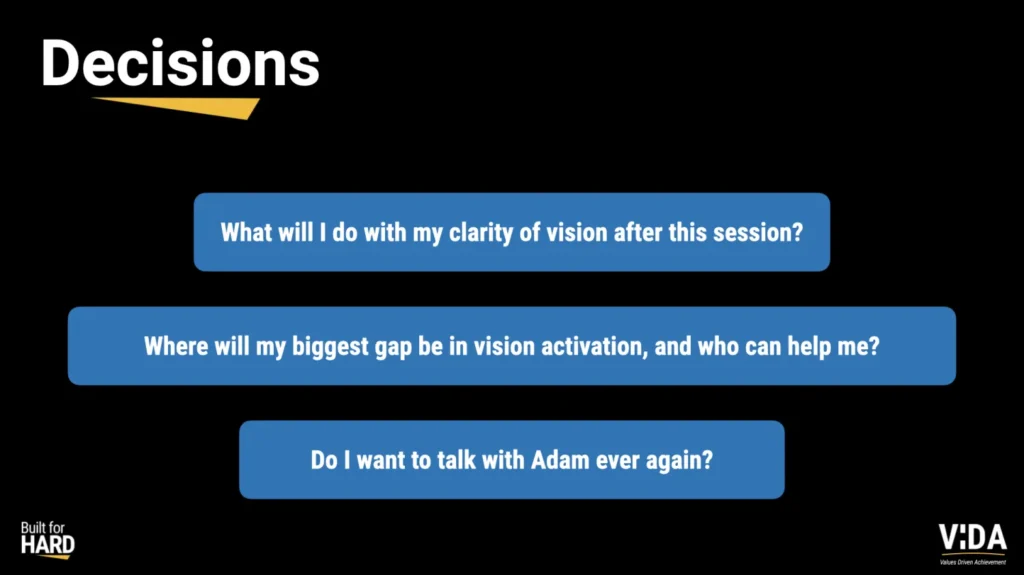
The POAD Template
Use this before your next meeting.
Purpose
We are meeting because:
This matters to the bigger picture because:
Outcomes
By the end of this meeting, we will have:
Agenda
We will structure the conversation this way:
- ____________________________________ Time: ______
- ____________________________________ Time: ______
- ____________________________________ Time: ______
- ____________________________________ Time: ______
Decisions
The decisions or next actions we need are:
Owner: ____________________ Due: _________________
Owner: ____________________ Due: _________________
Owner: ____________________ Due: _________________
A Simple Example
Weak meeting invite:
Subject: Team priorities
Body: Let’s discuss priorities for Q3.
Better POAD meeting invite:
Subject: Decide Q3 Team Priorities
Purpose:
We are meeting to focus our team’s energy for Q3 because we are carrying too many competing priorities and our execution rhythm is starting to weaken.
Outcomes:
By the end of the meeting, we will have selected our top three priorities, identified what will be paused, and clarified who owns the first next step for each priority.
Agenda:
Current reality — 10 minutes
Priority options — 20 minutes
Trade-offs and constraints — 15 minutes
Decision — 10 minutes
Owners and next steps — 5 minutes
Decisions:
What are our top three priorities?
What will we stop, pause, or defer?
Who owns each next step by Friday?
That is a meeting worth attending.
POAD Is a Leadership Practice
POAD is not just a meeting tool.
It is a leadership behaviour.
It forces you to slow down before you gather people. It asks you to respect the attention of your team. It makes you clarify the work before you ask others to help carry it.
That matters because meetings are never just meetings.
They are where culture gets trained.
If your meetings are vague, your culture becomes vague.
If your meetings avoid decisions, your culture avoids decisions.
If your meetings tolerate drift, your culture tolerates drift.
If your meetings create clarity, ownership, and movement, your culture learns to do the same.
This is especially important under pressure.
When work gets busy, leaders often skip structure because they feel they do not have time.
That is backwards.
Pressure is exactly when structure matters most.
The harder the work, the clearer the container needs to be.
Final Thought
Meetings should not drain the life out of good people.
They should focus energy.
Clarify reality.
Build trust.
Make decisions.
Move work forward.
The next time you call a meeting, do not start with the calendar.
Start with POAD.
Purpose. Outcomes. Agenda. Decisions.
Why are we here?
What are we trying to achieve?
How will we structure the work?
What needs to be decided, owned, and acted on?
Meet better.
Lead better.
Make the work worth the room.
–––––
Adam Kreek and his team are on a mission to positively impact organizational cultures and leaders who make things happen.
He authored the bestselling business book, The Responsibility Ethic: 12 Strategies Exceptional People Use to Do the Work and Make Success Happen.
Want to increase your leadership achievement? Learn more about Kreek’s coaching.
Want to book a keynote that leaves a lasting impact? Learn more about Kreek’s live event service.