
"The customer is the true north of entrepreneurship. Everything else is secondary."
Bill Aulet
MIT Professor
- Date
Disciplined Entrepreneurship
posted in Business Coaching

Adam Kreek
How Serious Founders Reduce Risk Before They Try to Scale
Bill Aulet’s 24-Step Framework Through a Values-Driven Lens
Most entrepreneurial advice sounds inspirational.
That’s not a compliment.
In practice, most founders do not fail because they lack grit, vision, or motivation. They fail because they run fast in the wrong direction, burn capital too early, and mistake enthusiasm for evidence.
Bill Aulet’s book Disciplined Entrepreneurship is a counterweight to that chaos.
It is not a mindset book.
It is not a motivational talk in paperback form.
It is a system. Twenty four clear steps designed to reduce uncertainty before you scale.
That matters deeply if you are building an innovation driven enterprise, not just a small business.
At VALUES Driven Achievement, we spend a lot of time helping leaders improve enterprise value through six core levers:
- Finances
- Sales
- Marketing
- Talent
- Leadership
- Productivity
Those levers matter. Immensely.
But here is the hard truth many founders discover too late.
Optimizing the engine does not help if you are pointed at the wrong mountain.
Disciplined Entrepreneurship is about aim before acceleration.
Innovation Driven Enterprises vs Small and Medium Enterprises
Before we dive in, let’s get clear on definitions.
Small and Medium Enterprises often compete in known markets, improve margins through execution and discipline, reach profitability earlier, and scale incrementally. The six lever enterprise value model works extremely well here.
Innovation Driven Enterprises are different. They pursue new or disrupted markets, face high uncertainty early, often invest before revenue, experience losses before traction, and aim for non linear growth.
This is the world Aulet designed his framework for.
In innovation driven enterprises, early discipline is not about efficiency. It is about survival and optionality.
Disciplined Entrepreneurship helps founders answer the hard questions before they hire aggressively, scale sales, or spend years building the wrong thing.
The Six Core Questions Behind the 24 Steps
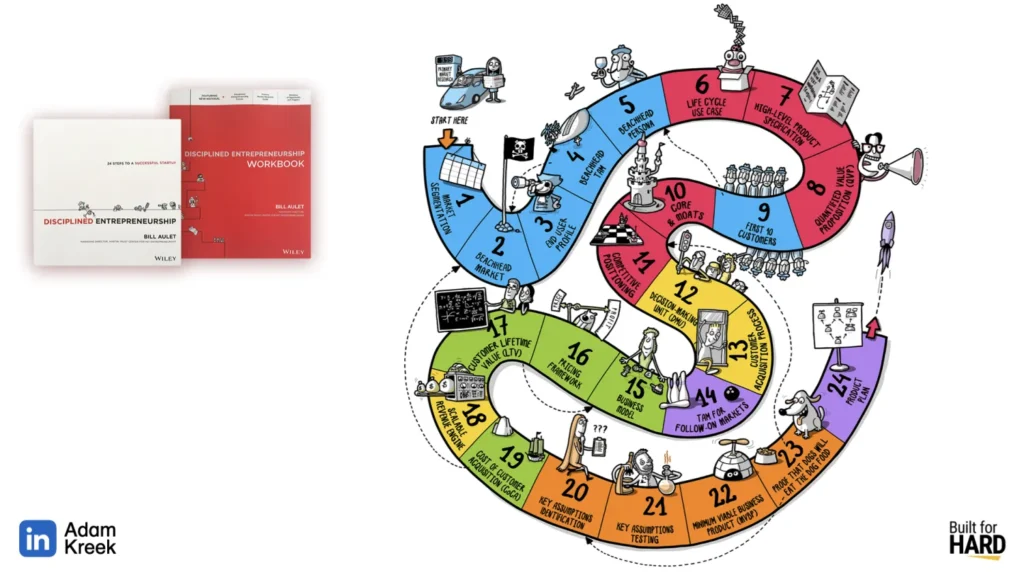
Aulet’s twenty four steps can feel overwhelming until you see the structure beneath them.
Everything ladders into six fundamental questions.
Who is your customer?
What real value do you create for them?
How do they acquire your product?
How do you make money sustainably?
How do you design and build what matters?
How do you scale without breaking the system?
If this feels familiar, it should.
These questions mirror the same logic behind enterprise value creation, leadership clarity under pressure, and the Built for Hard philosophy referenced across this blog.
Bill's 24 Steps Reframed for Leaders Who Want to Scan And Think Clearly
Rather than treating the twenty four steps as a checklist, think of them as a disciplined sequence of decisions.
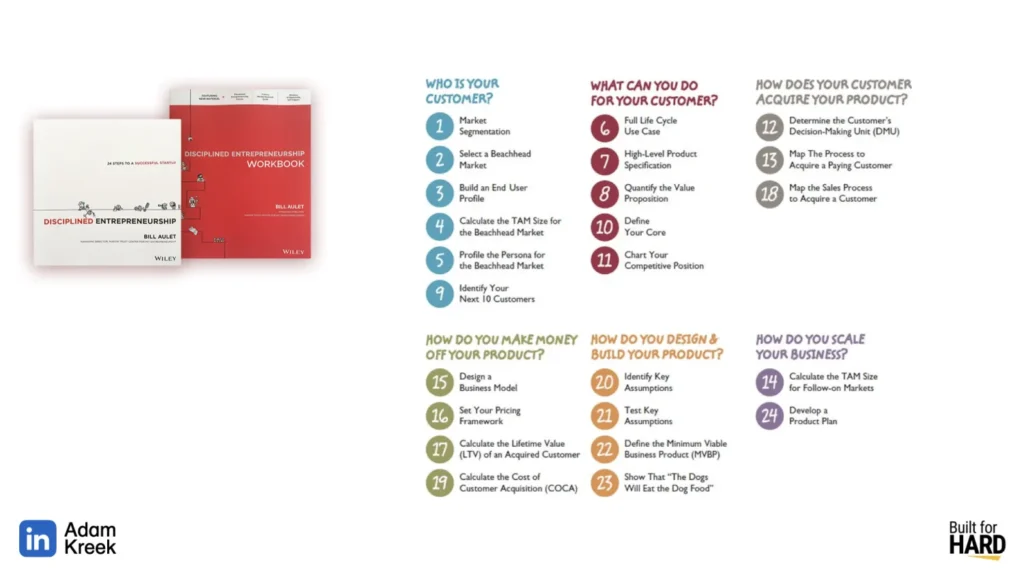
Below is a concise walk through of each step, what it is, why it matters, and where founders typically get it wrong.
Steps 1 to 5
Who Is Your Customer Really?
1. Market Segmentation
You divide the broad market into meaningful, distinct segments.
Why it matters
You cannot win a market you cannot clearly define.
2. Select a Beachhead Market
You choose one narrow segment to dominate first.
Why it matters
Focus increases speed, learning, and probability of success.
3. Build an End User Profile
You describe the environment where your product actually lives.
Why it matters
Products do not exist in theory. They exist inside messy systems, habits, and constraints.
4. Calculate TAM for the Beachhead
You size the actual opportunity using bottom up math.
Why it matters
Ambition without math is storytelling, not strategy.
5. Profile the Persona
You define the real human being who uses or champions the product.
Why it matters
Markets do not buy. People do.
Steps 6 to 11
What Value Do You Actually Create
6. Full Life Cycle Use Case
You map the entire journey from discovery through use and exit.
Why it matters
Most products fail at adoption, not functionality.
7. High Level Product Specification
You define what the product must do and no more.
Why it matters
Over building is one of the most expensive forms of procrastination.
8. Quantify the Value Proposition
You translate benefits into measurable economic impact.
Why it matters
Customers do not buy features. They buy outcomes.
9. Identify Your Next 10 CustomerS
You name real prospective customers.
Why it matters
Specificity forces honesty.
If you cannot name ten paying customer, you do not yet have a market. You have interest.
10. Define Your Core
You identify what truly differentiates you.
Why it matters
Without a core, you can grow but you cannot defend.
11. Chart Your Competitive Position
You map alternatives including doing nothing.
Why it matters
The status quo is often your strongest competitor.
Steps 12, 13, and 18
How Customers Actually Buy
12. Determine the Decision Making Unit
You identify buyers, users, influencers, and blockers.
Why it matters
Most deals die in procurement, not demos.
13. Map the Process to Acquire a Paying Customer
You document every step from awareness to payment.
Why it matters
Sales surprises kill cash flow.
18. Map the Sales Process
You define repeatable stages from lead to close.
Why it matters
If every sale requires heroics, scale will punish you.
Steps 14 to 19
How the Business Makes Money
14. TAM for Follow On Markets
You identify expansion paths and total accessable market (TAM) after winning the beachhead.
Why it matters
Vision matters. Sequence matters more.
15. Design the Business Model
You define how value is created, delivered, and captured.
Why it matters
A great product with weak economics is a short lived win.
16. Set the Pricing Framework
You price based on value, not fear.
Why it matters
Pricing is strategy, not arithmetic.
17. Calculate Lifetime ValuE
You estimate long term contribution.
Why it matters
Endurance beats bursts of revenue.
19. Calculate Cost of Customer Acquisition
You measure the full cost to win a customer.
Why it matters
If lifetime value is lower than acquisition cost, the business is structurally broken.
Steps 20 to 24
Proving the Business Before Scaling It
20. Identify Key Assumptions
You surface what must be true.
Why it matters
Unexamined assumptions quietly kill startups.
21. Test Key Assumptions
You replace opinions with evidence.
Why it matters
Discipline beats confidence.
This mirrors our emphasis on learning loops, reflection, and course correction under pressure.
22. Define the Minimum Viable Business Product (MVBP)
You prove the business works, not just the product.
Why it matters
An MVP proves usability. An MVBP proves viability.
23. Show That Customers Actually Use It
Customers use the product and get value from it.
Why it matters
Adoption is the only proof that matters.
24. Develop the Product Plan
You build a roadmap tied to evidence, not ego.
Why it matters
Momentum without direction is drift.
How This Integrates with VALUES Driven Achievement
Disciplined Entrepreneurship helps you earn product market fit.
Values Driven Achievement helps you compound enterprise value once fit begins.
Aulet’s twenty four steps reduce early risk.
Your six enterprise levers drive sustained performance.
Together, they build leaders and organizations that are disciplined, resilient under uncertainty, and capable of creating value that lasts.
Final Thought
Entrepreneurship does not need more hype.
It needs more clarity, sequencing, and discipline.
Bill Aulet’s work reminds us that courage is not reckless speed. Courage is slowing down, asking hard questions, and learning before the market teaches you the expensive way.
That is not just good entrepreneurship.
That is values driven achievement.
–––––
Adam Kreek and his team are on a mission to positively impact organizational cultures and leaders who make things happen.
He authored the bestselling business book, The Responsibility Ethic: 12 Strategies Exceptional People Use to Do the Work and Make Success Happen.
Want to increase your leadership achievement? Learn more about Kreek’s coaching here.
Want to book a keynote that leaves a lasting impact? Learn more about Kreek’s live event service here.