"Until you have a documented, repeatable, scalable system, you don’t have a business—you have a hustle."
Ryan Deiss
Author and Business Scaling Expert
- Date
Build Boat Speed, Not Burnout: The 6 Workstreams Every Business Must Strengthen
posted in Business Coaching

Adam Kreek
When Your Business Is Leaking...
By 10:30 on Monday, the owner had already done four jobs that were not technically his. He jumped into a sales call because nobody else could close it, approved a pricing decision because the margins lived in his head, calmed a wobble in the team because the meeting had no real container, and answered an operations question because the process still depended on tribal knowledge. The business looked busy. It even looked committed. But it was not building speed. It was borrowing energy from one human and calling it momentum.
That is a familiar stage in a growing business. Nothing is completely broken. Customers are coming. The team is trying. Cash is not catastrophic. And yet everything feels heavier than it should. The owner becomes the spare oar, the emergency bilge pump, and the unofficial feelings department, all before lunch.
That is usually not a motivation problem. It is a leak problem.
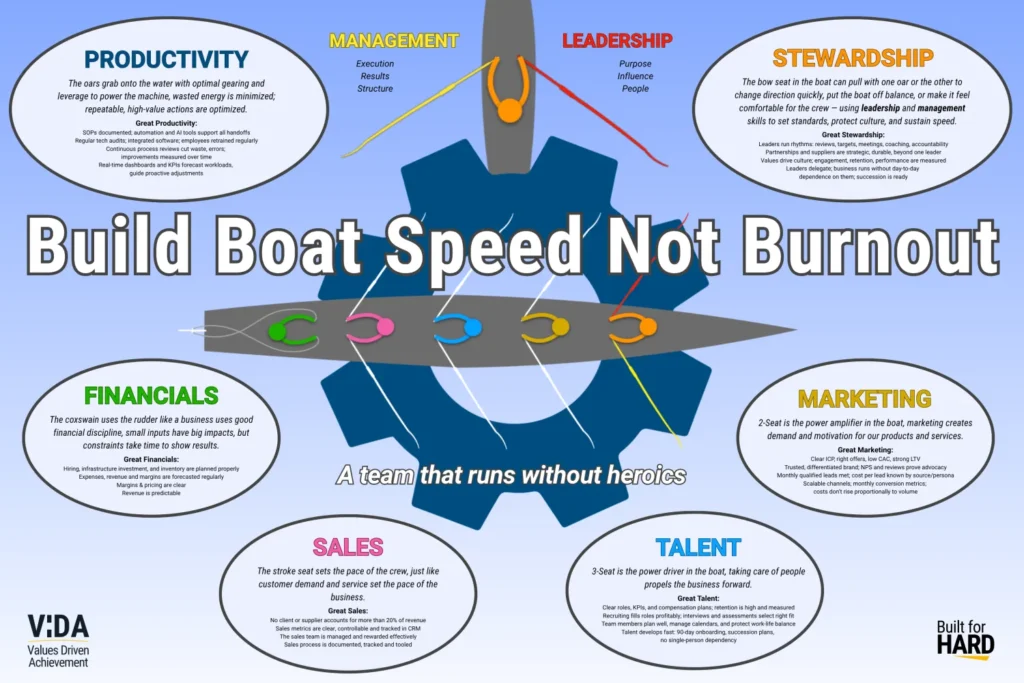
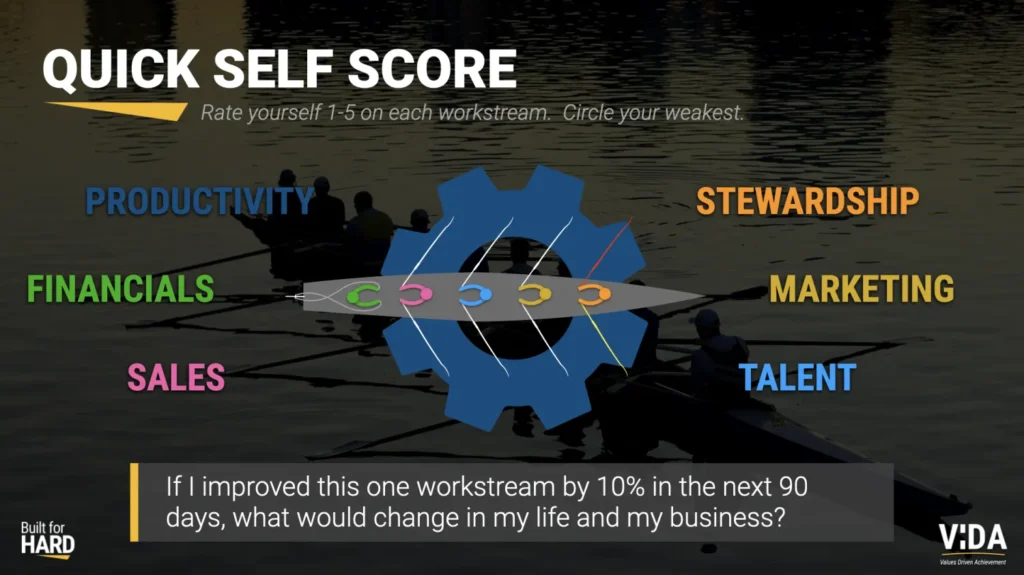
That picture is useful because each seat represents a workstream that does different work. You do not solve a sales leak with a prettier dashboard any more than you steer a rowing shell with motivational speeches. Financials helps you steer. Sales sets pace. Marketing amplifies demand. Talent supplies power. Productivity turns effort into useful motion. Stewardship keeps direction, standards, and stability intact. When leaders can name the the leaky workstream, they stop treating every drag on the business like a generic people problem.
Above the waterline, leaders stay clear enough to diagnose instead of dramatize. Containment is the quiet discipline of not spraying your unprocessed pressure into the crew. Once that is in place, the six workstreams become a practical way to read the business: where are we strong, where are we dragging, and who is quietly paying for the drag?
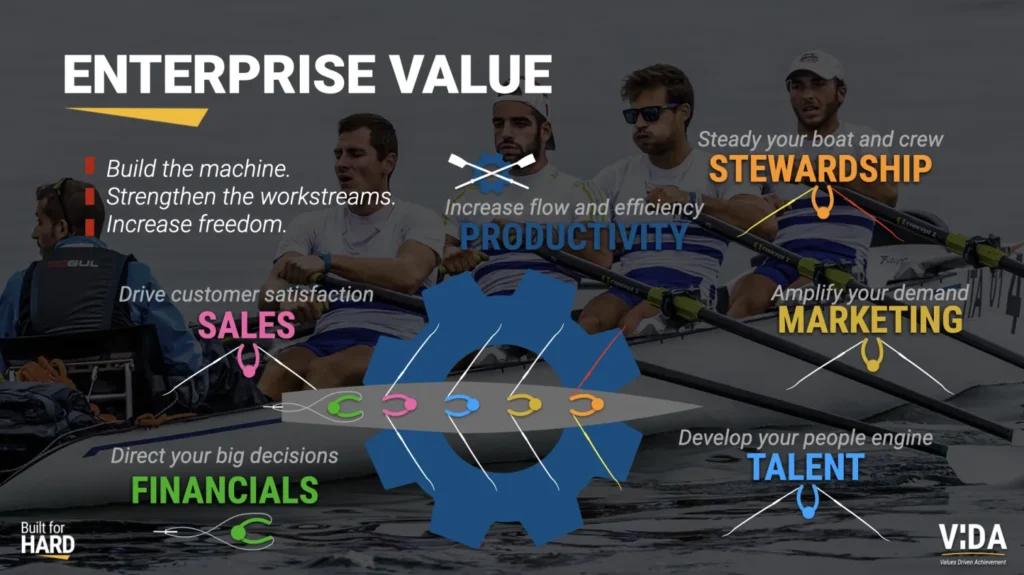
Enterprise value is not built by heroics. It is built by coordinated work strong enough to carry load without the owner rowing every seat.
Financials: the rudder.
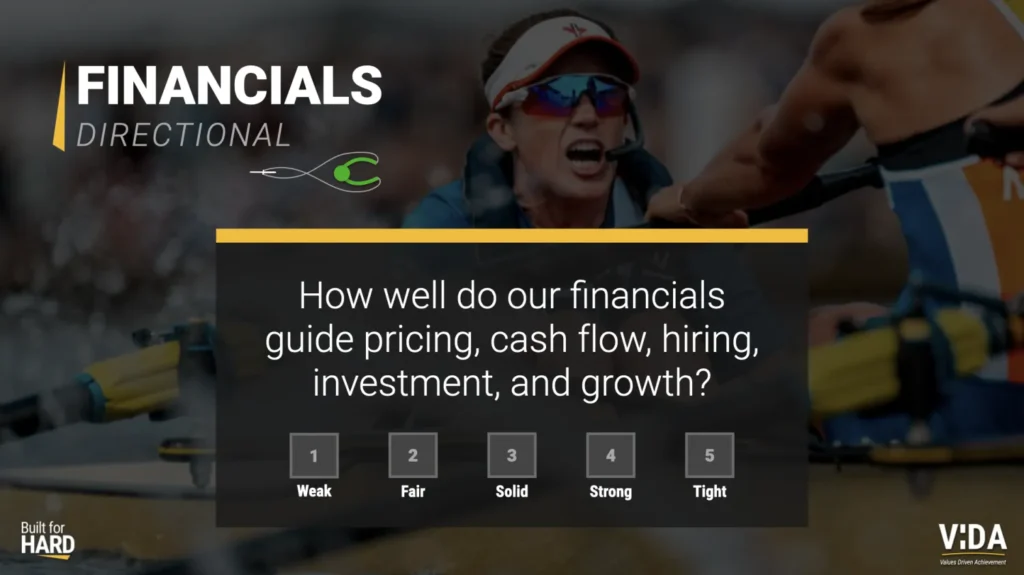
Financials functions like the coxswain’s rudder: small inputs, big consequences, slow feedback. In the Agile MSP Summit plan, the moment the event was given attendance targets, ticket pricing, sponsor revenue goals, and a revenue-positive objective, it stopped being “a good idea” and became a business system that could be steered. The main leak here is blurry economics. It usually shows up as runway amnesia, forecast fog, margin blur, and cash-conversion drag. When Financials leaks, leaders make emotional decisions with numerical vocabulary.
In one restoration business I coached, the company could produce strong work and respectable results, but working capital kept dragging. Insurance claims moved slowly, billing lagged, and the owner kept bridging the gap with personal effort and attention. The business looked more stable from the outside than it felt on the inside.
Main leak:
Blurry economics disguised as grit.
Four common sub-leaks:
- Runway amnesia, where hiring or investment happens without a cash plan
- Forecast fog, where revenue and expenses are reviewed too late to be useful
- Margin blur, where pricing sounds confident but profit by job type is not actually clear
- Cash conversion drag, where profit exists on paper but arrives on a different planet
When Finance leaks, leaders start making emotional decisions with numerical vocabulary. Everyone says “strategy,” or "muscle up."
The bank account says “interesting theory.”
Sales: the stroke seat.
Sales sets the pace of the crew, and the poster names it that way for a reason. Great Sales also means no client or supplier quietly controls the company by making up too much of revenue. Last year’s summit delivered strong content and strong feedback, but it did not generate leads or clients. This year’s redesign added a client story, a discovery-call offer, and structured follow-up. That is the difference between being appreciated and being bought. The main leak is popularity without pipeline. The usual sub-leaks are account concentration, CRM blindness, weak sales coaching, and founder-only selling.
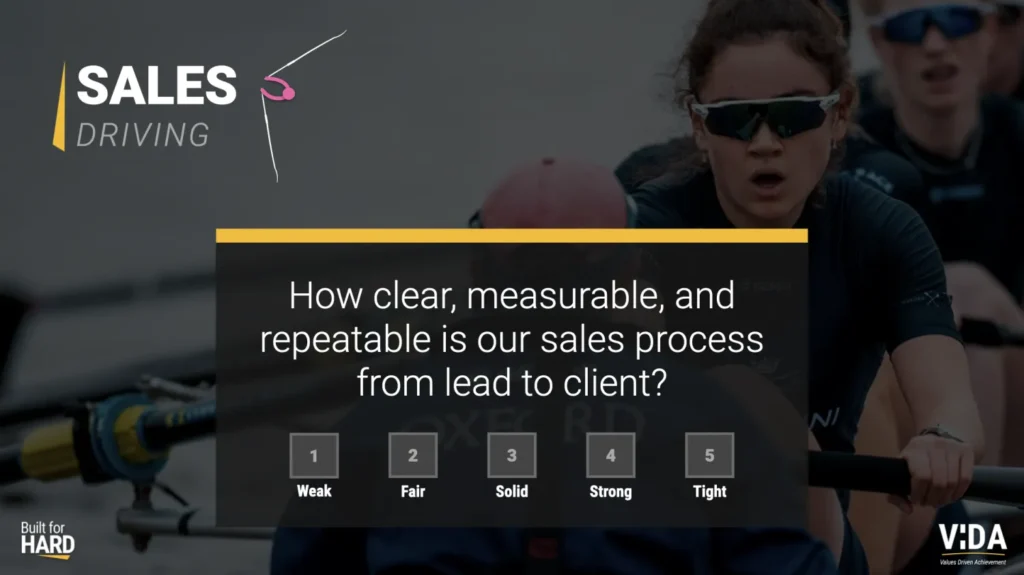
Last year, I worked with an event organizer who delivered strong content and strong feedback, but their conference did not create leads or clients for their business (the main goal beyond breaking even at the event). The following year’s redesign addressed this leakage directly: a client story on stage, a clear discovery-call offer, structured follow-up after the event, and a more intentional sales layer built into the day. Not pushy, just direct. That is a very useful distinction. Good experience is not the same thing as a working sales engine.
Main leak:
Being popular without having pipeline discipline.
Four common sub-leaks:
- Concentration dependency, where too much revenue sits in too few relationships
- CRM blindness, where the team has a system but no one trusts the data
- Unmanaged selling, where activity happens but coaching and incentives are weak
- Process heroics, where sales lives in the personality of one person instead of a repeatable method.
A business can be admired and still be unsold. Plenty of founders are well-liked. Fewer have a sales process that survives Tuesday's blow up.
Talent: the power driver.
The poster describes Talent as the 3-seat, the power driver in the boat, and it defines strength here with clear roles, measured retention, profitable recruiting, and fast onboarding. The Panther board makes that concrete: monthly visits to clients, learning the sales process by doing, working on quotes and RFPs, and onboarding CJ into Salesforce. That is talent development in plain clothes. The main leak is people carrying what the system should carry. It shows up as role fog, hiring roulette, calendar chaos, and key-person dependency.
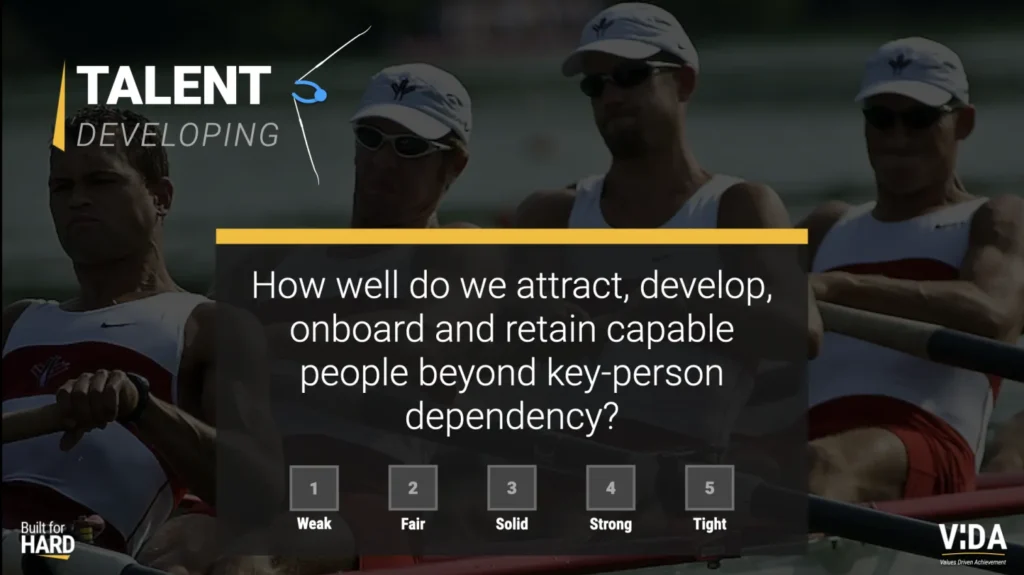
A business can look committed, full, and hardworking while still leaking badly.
A packaging and sales company had very strong values, and a noble purpose of supporting their people. The work elevated when it was not framed as abstract “people development.” Building the talent engine became deeply concrete: get closer to clients and the sales process, schedule regular visits, align travel with RFP timing, learn by doing, and onboard the new promotion into Salesforce. That is what healthy talent work looks like in real life. Not vibes. Formation. Capability. Repetition. Calendar entries.
Main leak:
People are carrying what the system should carry.
Four common sub-leaks:
- Role fog, where accountability is fuzzy
- Hiring roulette, where recruiting fills seats but not fit
- Calendar vandalism, where everyone is overloaded and calls it commitment
- Key-person dependency, where onboarding is thin and succession is mostly prayer with a spreadsheet
When Talent leaks, your best people slowly become search engines, shock absorbers, and emotional support systems for everybody else.
They are impressive. They are also leaving.
Marketing: the power amplifier.
Marketing is not noise. It is demand made legible. In the poster, Marketing is the 2-seat power amplifier, with clarity around ICP, offers, CAC, LTV, reviews, and conversion metrics. The summit strategy tightened the audience to MSP owners, service managers, operations leaders, and non-technical leaders, then aligned promotion through direct outreach, LinkedIn, sponsor co-promotion, clients, and warm networks. That is what a clear ICP looks like when it leaves the whiteboard. The main leak is broad noise instead of targeted resonance. The common sub-leaks are fuzzy ICP, weak proof, lead-source blindness, and channels that get more expensive as volume rises.
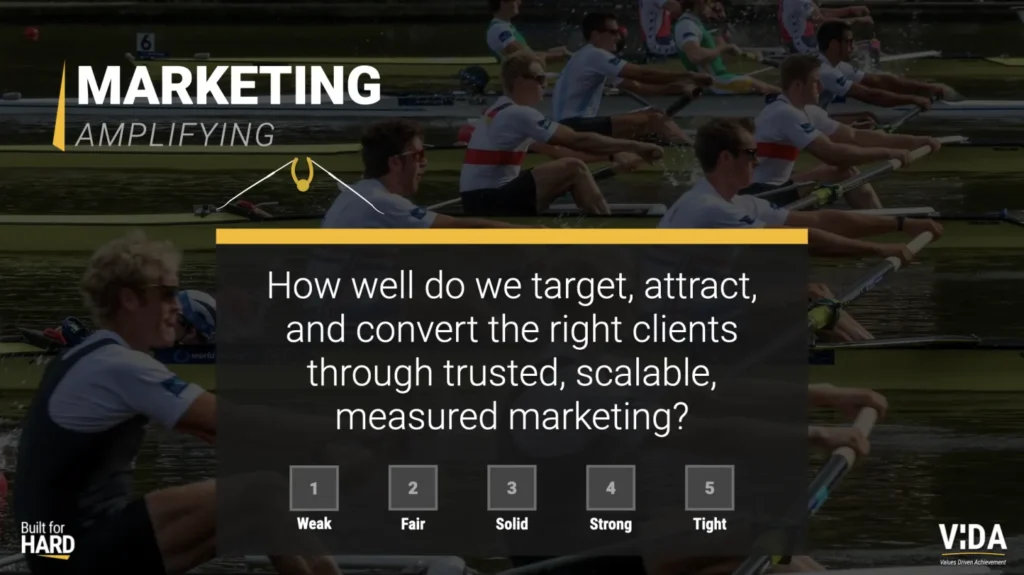
A past client made significant progress when they saw, understood and applied the difference between broad promotion and disciplined marketing. The audience was narrowed significantly to address MSP owners and their operations leaders. The content themes were tightened. Promotion was mapped through direct outreach, LinkedIn, sales development rep follow-ups, client advocacy, sponsor co-promotion, and warm feeder networks.
That is not “doing some marketing.” That is trying to make demand legible.
Main leak:
Shouting enthusiastically in the general direction of “the market.”
Four common sub-leaks:
- Fuzzy ICP, where the message is too broad
- Weak proof, where trust is assumed rather than evidenced
- Lead-source blindness, where the team cannot say which channels or personas actually work
- Unscalable channel mix, where every new lead costs more than the last one
A lot of businesses do not have a marketing problem. They have a clarity problem wearing a marketing hat.
Stewardship: the bow seat.
The poster puts Stewardship in the bow seat: the place that can subtly change direction, unsettle the crew, or make the whole boat feel steadier. It is where leadership and management meet to set standards, protect culture, and sustain speed. The Panther board shows that work in ordinary form: board meetings scheduled, concerns prioritized, follow-up assigned, inventory transition clarified. And the Human Ethic manuscript sharpens the posture underneath it: stewardship begins when the question is no longer only “How do I succeed?” but “What am I now carrying for others?” The main leak is leadership weather leaking into the system. Its sub-leaks are rhythm decay, relationship fragility, values as wallpaper, and delegation theatre.
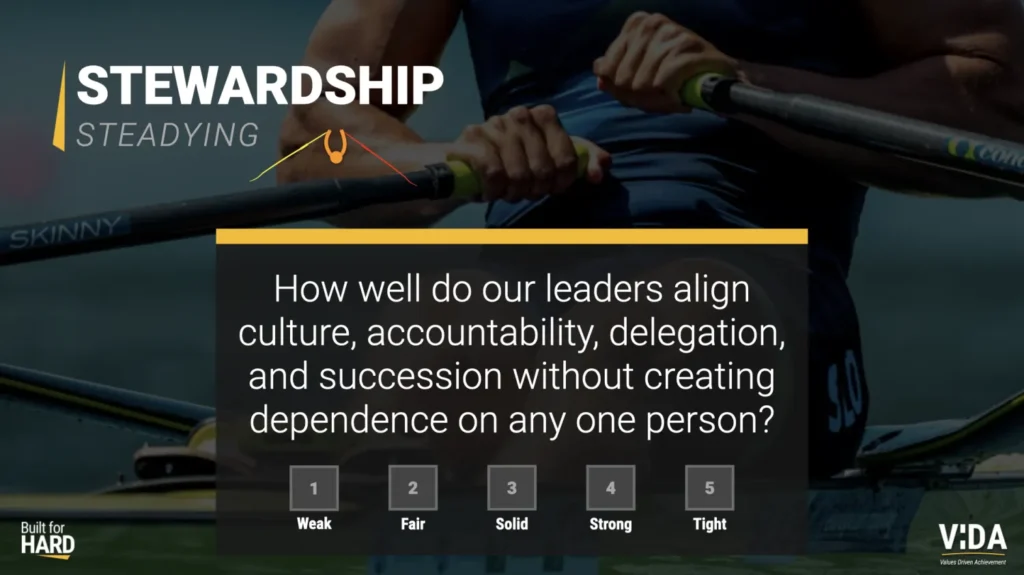
A medical office I coached broke through their ceiling when they embraced stewardship as architecture, not personality. Board meetings became scheduled. Stakeholders were identified. Concerns were recorded and prioritized. Follow-up was assigned to specific people. Communication options became clarified. Inventory transition now had named ownership.
That is stewardship. Not just caring, but carrying.
The mature question is no longer only “How do I succeed?” but “What am I now carrying for others?” and “What must still remain true after I am done?”
Main leak:
Leadership weather leaking into the system.
Four common sub-leaks:
- Rhythm decay, where meetings and reviews happen inconsistently
- Relationship fragility, where partners or suppliers depend on one person
- Values as wallpaper, where culture is talked about but not measured or reinforced;
- Delegation theatre, where work is “handed off” but authority, clarity, and succession are not.
When Stewardship leaks, the business may still look organized for a while. But it becomes increasingly expensive to preserve the appearance.
Productivity: the oars grabbing water.
Productivity is where the boat actually takes hold of the water. The poster defines it as leverage, minimal wasted energy, documented handoffs, and real-time visibility into workload. The TopLeft material gives that teeth: clients seeing 15–25% capacity recovery and, in some cases, 58% faster project delivery. That is not everyone trying harder. That is cleaner flow. The main leak is friction tax. It usually appears as handoff guesswork, tool sprawl, invisible rework, and reactive capacity management.
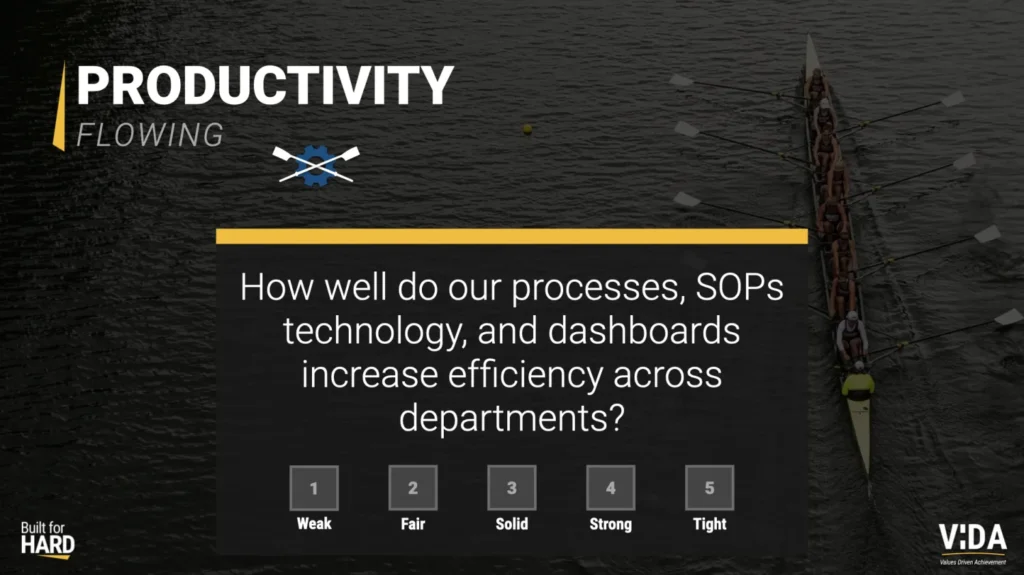
A software company I coached built their productivity workstream around pull-based operations, workshop application, and peer problem-solving rather than passive content. More importantly, their productivity initiatives kept client outcomes as the core focus: 15 to 25 percent capacity recovery and, in some cases, 58 percent faster project delivery. That is what happens when flow improves and work stops ricocheting around the building like a racquetball.
Main leak:
Friction tax.
Four common sub-leaks:
- Handoff guesswork, where steps live in memory instead of process
- Tool sprawl, where software multiplies but flow does not
- Invisible waste, where errors and rework are irritating but unmeasured
- Reactive capacity management, where workload is discovered late instead of forecast early
When Productivity leaks, leaders often accuse the team of not moving fast enough. Usually the team is moving plenty. The work is just wearing ankle weights.
Practical use of the model
Why does any of this matter? Because visible success is often financed somewhere else: the business looks fine on the surface, but the real cost is being billed to exhausted people, confused relationships, and future clean-up.
That is why some companies grow and still feel strangely brittle. Their speed is real, but it is being paid for in places the dashboard does not show.
When visible success is financed by hidden burden, burnout is not a people problem. It is a system problem.
This is what makes the framework useful for founders, managers, and high-responsibility leaders. It is not a shame tool. It is a diagnostic. When the business feels heavy, do not ask only, “Who needs to work harder?” Ask better questions. Which workstream is leaking? What is the main leak? Which four sub-leaks are most present? And what leadership or management correction is needed above the boat?
Look for the main leak in each stream.
- In Finance, ask where the numbers are lying by delay.
- In Sales, ask where demand depends on personality instead of process.
- In Talent, ask where people are compensating for structural weakness.
- In Marketing, ask where effort outruns clarity.
- In Stewardship, ask where leadership weather is shaping the culture.
- In Productivity, ask where friction is quietly taxing the whole machine.
The Goal is Freedom
The goal is not perfection. The goal is quicker recovery, clearer diagnosis, and stronger coordination. Some weeks you will still have to grab an extra oar. Fine. The problem is when extra effort becomes the operating system. Businesses lose value when heroics become normal and truth becomes expensive.
Because that is the real sequence. Lead above the waterline. Contain what would otherwise leak. Strengthen the six workstreams. Build enterprise value.
Owner freedom rises when the workstreams become stronger than the owner’s daily heroics. Teams get steadier. Decisions get clearer. Truth gets cheaper to tell. The company becomes more valuable because it becomes more durable, more transferable, and less dependent on one person having a heroic week.
That is how you build boat speed, not burnout. That is how you get a team that runs without heroics. And, mercifully, that is how the founder gets to put down the bucket.
The goal is not to row harder forever. The goal is to build a boat that carries the load.
–––––
Adam Kreek and his team are on a mission to positively impact organizational cultures and leaders who make things happen.
He authored the bestselling business book, The Responsibility Ethic: 12 Strategies Exceptional People Use to Do the Work and Make Success Happen.
Want to increase your leadership achievement? Learn more about Kreek’s coaching here.
Want to book a keynote that leaves a lasting impact? Learn more about Kreek’s live event service here.